Christmas Bird Count seeks volunteers to carry on 125-year tradition

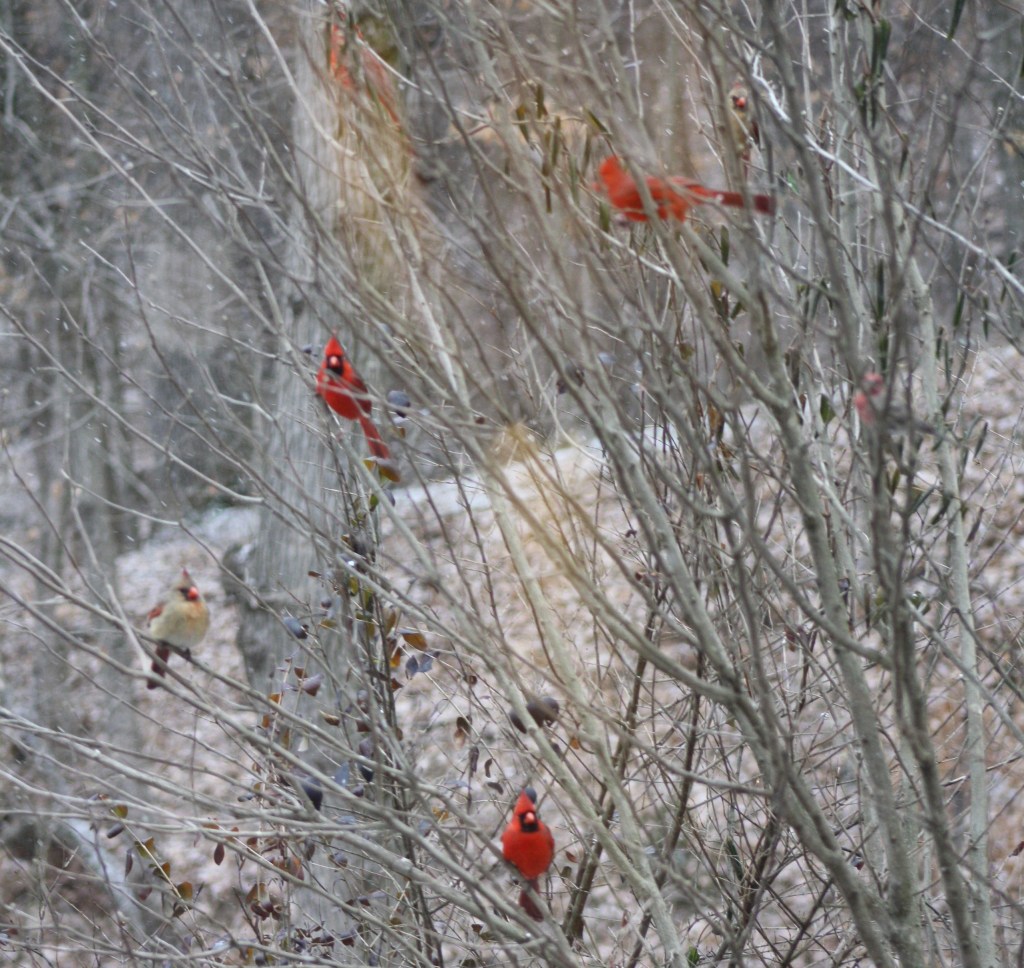
Audubon’s annual Christmas Bird Count was founded 125 years ago to replace a tradition of shooting and killing birds for sport.

The Thanksgiving Day celebrations are barely behind us, and we are already full speed ahead toward Christmas. One holiday tradition celebrates its 125th anniversary this year, and it continues to grow and add new participants each year.

The Audubon Society’s annual Christmas Bird Count (CBC) was initiated in 1900 by a bird fan who suggested that families spend their Christmas Days together documenting birds they see and hear rather than the time-honored task of going out in groups to shoot as many winged creatures as possible.

It is nearly unfathomable that such a practice was taking place barely a century ago in this country to the point that someone was inspired to offer an alternative. I know that I was not above killing birds for the fun of it less than 50 years ago, so what may be more surprising is that the idea actually took off.

Thousands of volunteers in more than 2,000 locations across the western hemisphere will go out for one day between December 14 and January 5 and record all the birds that they encounter in their specific area. All of that data is collected to create one of the largest sets of survey information in the world. Bird biologists, naturalists, and environmental planners study the science to make recommendations based on the trends of recent years and decades.

Anyone with an interest in birds is welcome to participate. CBC Circles have a 15-mile radius and are led by a compiler. Joining the effort is as simple as reaching out to the organizer and expressing a willingness to brave the winter weather for the benefit of a few feathered friends.

The only circle that catches an area of Jefferson County is based near Maeystown, Illinois. The edge of the circle crosses the Mississippi River just north of Crystal City and follows the riverfront to just south of the Truman Access. Michael Avara is the compiler for the Monroe County circle and can be reached via email at avara@illinois.edu.

Missouri hosts about 20 CBCs. Learn more at audubon.org/conservation/join-christmas-bird-count and contact the CBC organizers listed for details on the specific count circles.

St. Louis area circles are based at Weldon Springs in St. Charles County, near Fort Bellefontaine in north St. Louis County and outside of Collinsville in Madison County, Illinois. Immediately south of Jefferson County are circles east of Perryville and at Johnson Shut-Ins State Park.

If the event date is more important than location for planning purposes, the local circles are all scheduled to conduct their surveys on different dates. The Weldon Spring survey will be held on Dec. 15. The Maeystown date is Dec. 27, and Collinsville will go on Dec. 28. The Fort Bellefontaine date is Jan. 1. The circle from Johnson Shut-Ins will look for birds on Jan. 3, and the Mid-Mississippi River group near Perryville is scheduled for Jan. 4.

Beginning birders can be paired with more experienced participants, but everyone starts by signing up online with the organization’s Community Science program. Those who join receive a quarterly online publication called American Birds.

The newsletter includes information on all of the work by Audubon toward saving and studying bird species. It also brings the story full circle. Frank Chapman, publisher of Bird Lore, was the man who suggested the Christmas Bird Count 125 years ago. His publication evolved to become Audubon Magazine. Nature lovers have the chance to carry on his holiday tradition.

John Winkelman has been writing about outdoors news and issues in Jefferson County for more than 30 years and was the Associate Editor for Outdoor Guide Magazine.

Different traditional Thanksgiving feast comes a week early

As people who enjoy the outdoors, we have much to be thankful for. The beauty and bounty of nature can sustain us physically and spiritually. Spending time in the fresh air is restorative, and the nutritional value of wild game exceeds almost anything you can buy in the store. It also can be really tasty.

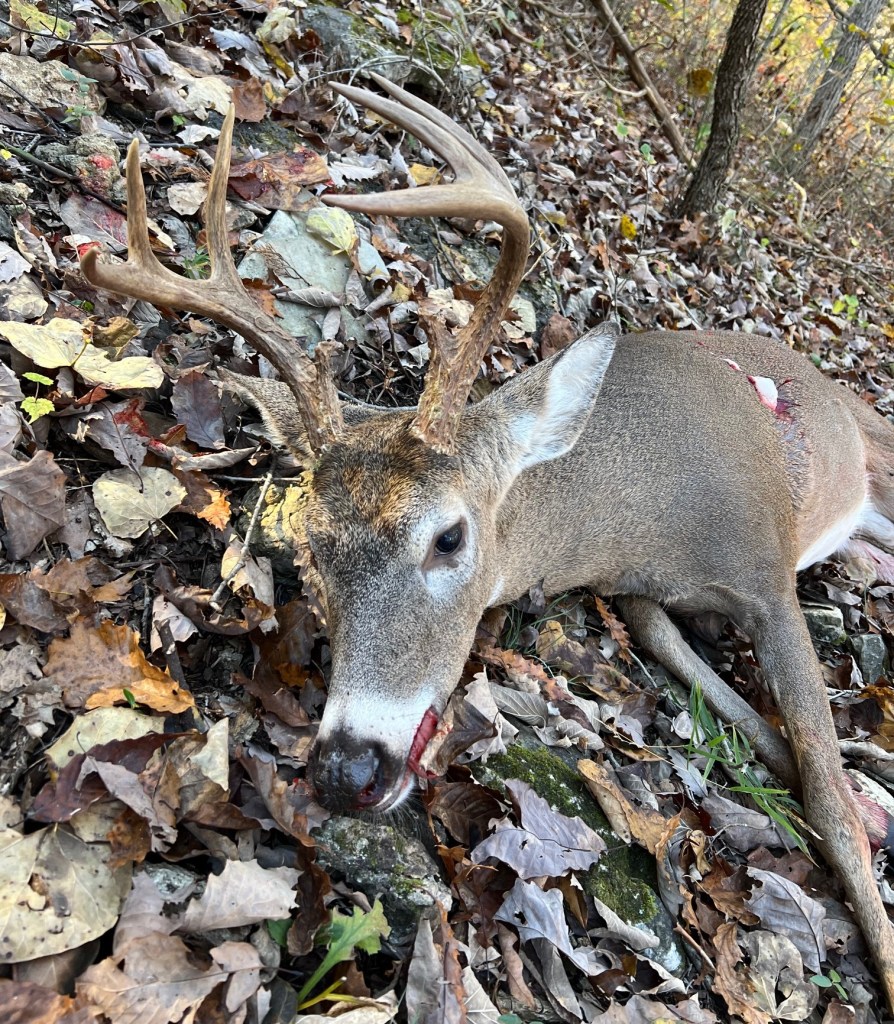
I thought of Thanksgiving as we enjoyed each of our evening meals during the opening weekend of deer hunting season. On Friday night the menu included fried fish from a late summer visit to the lake. Saturday evening we dined on boneless venison chops from a buck harvested during the first half of bow season, and Sunday night’s feast featured turkey nuggets from a fall gobbler.

I would share the recipes, but our meal preparation is more process than prescription, so there is nothing written down.

Fresh-caught fried fish makes for a fine Friday night meal anytime of the year.

The fish fry procedure produces the only divided loyalty. Lucky Jim prefers Louisiana brand fish breading, while I am an Andy’s guy. Both are good alternatives, and my plan blends one bag of Yellow and one bag of Red for the perfect balance spice and spunk. Still, I never question Jim’s choice because the Baton Rouge company has been getting it right for 60 years.

There is no debate about the side dish on Friday night. Russet potatoes are sliced pencil thin and soaked in ice water before getting submerged in the hot grease after the fish is all cooked. The floating breading and spices cling to the french fries, so that they do not need any additional seasoning.

We have tried a few other options for the butterfly-sliced, lean deer meat that most people call back straps or tenderloins. I don’t mean to be a snob about it, but I prefer to refer to the cut as boneless chops. The true tenderloin is accessed from inside the carcass, and back strap just seems a little too crude for a connoisseur.

The popular method of wrapping the filets in bacon adds flavor and fat, and a bit of a mess. We have gone to almost exclusively enjoying them after soaking the steaks for a few hours in marinade. Dale’s Seasoning originated at a restaurant in Birmingham, Alabama, 70 years ago and bills itself as the No. 1 marinade in the nation. We use it when we can’t get Andria’s Steak Sauce from the fine dining establishment in O’Fallon, Illinois. Both of the dark, rich sauces really amplify the flavor.

A few minutes on a hot grill is all it takes to turn those steaks into something special. A little bit of horseradish sauce or A-1 for dipping is never a bad idea. Stirring the two together on the plate edges on perfection.

The wild turkey breast requires the most preparation work. It needs to be closely trimmed of any connective tissue and then cut into small chunks. We soak the pieces in milk and then in a scrambled egg wash before dredging them in a combination of flour, crushed cracker crumbs, salt and pepper.

A minute or so in the hot oil (350 F) turns them into slowly bubbling and brown beauties before draining them on a paper towel. Ranch or Buffalo sauce makes for good dipping, but the nuggets are enjoyable enough without condiments.

We also managed to have wild game on the menu for lunch each day. Sliced deer summer sausage and cheese is an easy favorite anytime of year. For the other two days, the mid-day meal was traditional chili and vegetable soup that both substituted venison burger for the beef.

Even when the hunting is slow, one thing is for sure at deer camp, we are going to have plenty of good food to eat. I loved the time with family enjoying all the fine fixings that accompany the familiar Thanksgiving Day table, but our deer season dining is always tough to top.

John Winkelman has been writing about outdoors news and issues in Jefferson County for more than 30 years and was the Associate Editor for Outdoor Guide Magazine.

Joachim Loop Trail in Herculaneum welcomes all walkers

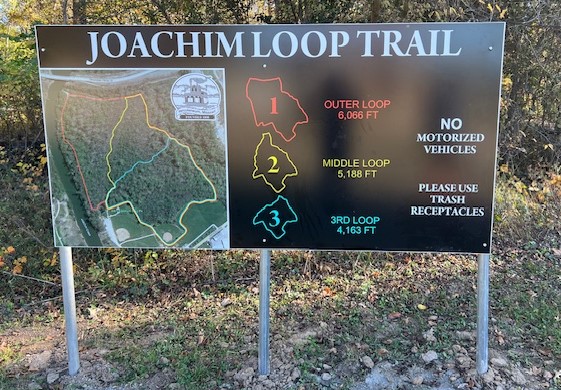
Walkers have multiple options for exploring the Joachim Loop Trail at William C. Haggard Park in Herculaneum.

A cool autumn afternoon with the forest of trees near their peak for fall colors may have been the best possible day to explore the Joachim Loop Trail at William C. Haggard Park in Herculaneum. But multiple times on the walk, I thought the path could be nearly perfect any time of the year.

For hearty hikers the trip does not provide challenges of craggy cliffs or steep slopes. The elevation changes are barely noticeable, so for those looking for a pleasant stroll in the outdoors, few places in Jefferson County can match the march through the wooded flood plain.

Like the all-inclusive Kade’s Playground that welcomes children of all abilities to play at the same park, the crushed rock trail provides easy passage for strollers, wheelchairs and any other conveyance assistance. I found a few muddy spots the day after a significant rainfall, but such is life in the lowlands.

The main outer loop trail is 10-feet wide and nearly 1.2 miles long. Two six-foot wide interior cutoffs allow your walk in the woods to be shortened to just more than a half-mile, or it can be a place you can wander for hours in peace among the leaves.

An old concrete dam backs up Joachim Creek at a overlook area along the trail.

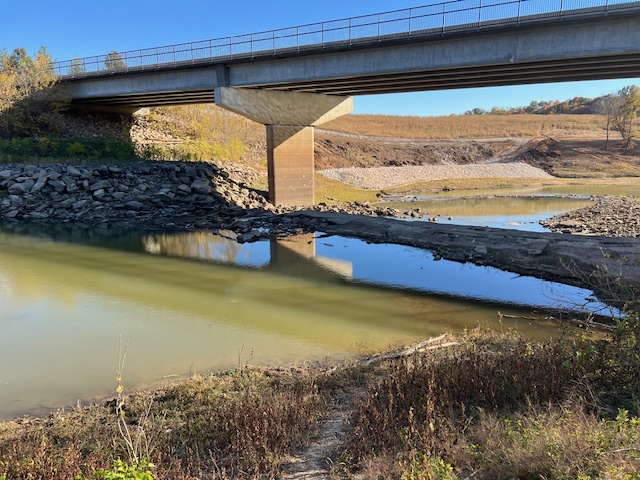
Following the west bank of the Joachim Creek, the initial segment of the outer loop makes its first hard right turn at an overlook bench where you can watch the water tumble over and old concrete dam. The tall bridge overhead hardly distracts from the serenity.

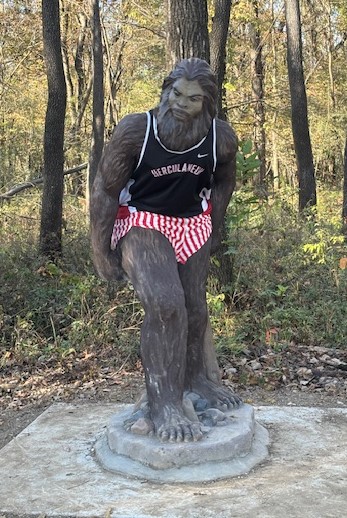
A bigfoot statue marks the intersection of the outer and middle loop of the Joachim Trail.

The trail’s most unique feature marks the intersection of the outer and middle loop. Standing guard at the crossroad corner is a five-foot tall Sasquatch statue. Adorned in a traditional Herculaneum Blackcats cross country jersey and striped shorts, Bigfoot will inspire more smiles than scares. (Unfortunately the second time I walked the trail, he had been stripped of his garments.)

Another hard right turn leads to the third loop, the shortest of the diagrammed trails at just over three-quarters of a mile. Even though there are no colored blazes to line the paths, one of the beauties of the connected loops and wide tracks is that you can’t find yourself lost. Everything ends up right where you started and the final quarter-mile or so of all three designated trails is out of the woods and along the park’s fairground areas and baseball fields.

As we walked, we imagined the route in winter time. The crushed rock would provide a quick-drying, hard surface and enough sunlight could filter through the trees to warm up chilly skies. The potential for a variety of river land wildflowers along the path through spring would be inviting when the thaw arrives. Summer trips could include kids in action on ball fields. The playground we walked past was busy with littles on a Sunday afternoon, and the park’s other prime feature welcomed several guests as well. All Bark Village allows pets to run and play on two different fenced-in fields.

The streamside trail does not showcase any spectacular views, although watching creek water flow always has an allure. A soaring bald eagle spotted from the parking lot multiplied the place’s cool factor. The forested flats depict a typical woodland, but other than the bald eagle, I didn’t see wildlife beyond birds and squirrels. I’m sure a white-tailed deer sighting would not be uncommon a different time of the day.

The other thing I didn’t see too much of made me happy. Someone has put in significant effort into controlling honeysuckle bushes and other invasive species. There are a few areas with unchecked undergrowth, but most of the wooded area was open for wildlife watching.

Easy to get to and easy to navigate, the Joachim Loop Trail offers a taste of the outdoors for everyone to enjoy.

John Winkelman has been writing about outdoors news and issues in Jefferson County for more than 30 years and was the Associate Editor for Outdoor Guide Magazine.
Public input sought on development of Jay Nixon State Park

A couple of weeks ago I wrote in the Jefferson County Leader about upcoming meetings at Taum Sauk State Park and Jay Nixon Backcountry. Due to recent flooding in the area, guided hikes scheduled for the two areas have been postponed until Dec. 7. Below is that column with the new dates.

Many moons ago when I was just getting my feet wet in the Jefferson County journalism business, another young whippersnapper was creating a name for himself on a much larger scale.

Six years my senior, Jeremiah “Jay” Nixon had the audacity to take on the county’s political establishment. State Sen. Clifford “Jack” Gannon was retiring, so Sheriff “Buck” Buerger and Commissioner Ralph Krodinger were in line to ascend to the prime post. If you know any local government history, those three guys were giants.

But 30-year-old Nixon ran all over the county in 1986 asking people to elect him and promising to bring home “Our Fair Share.” The young De Soto attorney prevailed. He may not have found enough support in a two-way race, but with the electorate split fairly even among the three candidates, a new career was launched. As for his promise, his time in Jefferson City coincided with major progress on projects in Jefferson County like new Highway 21, Hwy. M, and expansion of Interstate 55 and Hwy. 30.

I remember a cartoon by the late, great Judy Dixon that showed Jay leading his then-newlywed wife Georgeanne up a mountain. I’m do not recall if the White House was at the top of that summit, but the implication was that he was set to conquer some political heights.

He never made it to Capitol Hill, but he did serve 16 years as state Attorney General, and in 2008 he was elected to be the 55th governor of Missouri. The last Democrat elected to that job, he served for two terms until 2017. Ironically, one of the things he was noted for was cutting government spending. That’s something we still hear about these days but rarely see.

Another area where Nixon established an affinity was for the environment, parks and recreation. He worked to bring several new public properties into state control, providing potential places for everyone to use and enjoy. His reputation was such that the state Department of Natural Resources sought to name one of those tracts for the former governor.

That acknowledgment was not popular with the Republican-controlled legislature, so in the spirit of partisanship Proffitt Mountain State Park was offered as an alternative name. As a long-time Jefferson County resident, I like the property being named for a local who earned the recognition through his service and commitment to public recreation access.

Those who don’t like the name and anyone else who wants to provide input about the 1,230-acre property are invited to an upcoming annual informational meeting at 9 a.m. on Dec. 7 at Taum Sauk State Park. The open house will share long range plans for Jay Nixon Backcountry and Taum Sauk parks.

These annual meetings ask for comments from the public, and for those who cannot attend, an online survey will also be available for 30 days beginning Dec. 7 at mostateparks.com/CDP. Nixon State Park is not open to the public yet as the agency continues to plan its development, so the state is offering an opportunity for a limited number of people to explore the property.

As part of the annual meeting, a guided hike and overnight camping experience is planned. Participants will hike nearly nine miles with all their gear, spend the night in the backcountry and then hike the nine miles back out the next day. While that may have seemed an exciting opportunity to me when Jay and I were younger, I’m going to leave an open spot for the governor or someone else.

More my speed these days is a chance to hike Mini Sauk Falls Trail at 10:30 a.m. on Dec. 7 in conjunction with the public meeting. The 3.5-mile loop is a strenuous circuit, but the pay off is a visit to the top of Taum Sauk Mountain, the highest peak in Missouri, and a view from the top of Mini Sauk Falls, the largest waterfall in the state.

To find out more about the conceptual development plans for Taum Sauk State Park and Jay Nixon Backcountry call 573-522-0571. Information on all of Missouri’s state parks and historic sites is available at mostateparks.com.

John Winkelman has been writing about outdoors news and issues in Jefferson County for more than 30 years and was the Associate Editor for Outdoor Guide Magazine.

Support for native plants and species comes to Powder Valley

Entomologist and author Doug Tallamy will talk about the importance of native species in a virtual presentation on Nov. 1 at Powder Valley Conservation Nature Center.

When I noticed that Doug Tallamy was the guest speaker for an upcoming program at Powder Valley Conservation Nature Center, his name sounded familiar. I quickly recognized that he was the author of a great book I read recently that offered a simple plan for conservation.

My excitement was tempered when I realized he wasn’t actually going to be in Kirkwood at 7 p.m. on Nov. 1, but as I considered the situation, the virtual program option might be even better. While an author’s autograph on a copy of Nature’s Best Hope would be a nice prize, being able to hear his presentation in my home office has a real allure too.

The entomology and ecology professor’s 2020 best-seller is a follow up to his similar, previous book Bringing Nature Home. The free program at Powder Valley will highlight his latest offering, A Chickadee’s Guide to Gardening. The concept of all his works is the importance of encouraging and protecting native species.

His solution from Nature’s Best Hope is to establish miniature parks that focus on native species in backyards across the country. Not big tracts of land for someone else to maintain, but millions of individual efforts. If every suburban yard had a 10-by-10 native garden, the restored land would provide more habitat than our biggest parks combined, he says. Those locations would attract the insects that have evolved alongside the plants for millennia, providing food for birds and other wildlife that rely on them to sustain their populations.

“In the past we have designed our landscapes strictly for our own pleasure, with no thought to how they might impact the natural world around us,” Tallamy says in a press release from the state Department of Conservation. “Such landscapes do not contribute much to local ecosystems and support little life.”

As evidenced in the title of his newest book, Tallamy focuses on the role of the chickadee, one of the most common birds at our feeders. By creating landscapes that look more like places where those small birds and other species have lived forever, the benefits extend to all backyard gardening efforts.

The doors at Powder Valley will open at 6 p.m. so guests may tour the center’s exhibits and visit with volunteer staff at tables to talk about topics like Missouri native plants and pollinators. Visitors will also have the opportunity purchase Tallamy’s books. All who attend in person will have the chance to take home wildflower seed packets.

The presentation will be shown on the screen in the Powder Valley auditorium, or those who register in advance may log in and watch from their personal computer or other internet-linked device at home.

More than 100 of 250 available “seats” remained at the end of last week. To receive a link to the virtual program via email, go to http://short.mdc.mo.gov/4DH. A link will be provided before the program. All who register must provide a valid email address where the link can be sent.

Powder Valley Conservation Nature Center is at 11715 Cragwold Road in Kirkwood, near the intersection of Interstate 270 and I-44. To receive email or text alerts about future programs and events in the St. Louis area visit https://short.mdc.mo.gov/ZoP.

John Winkelman has been writing about outdoors news and issues in Jefferson County for more than 30 years and was the Associate Editor for Outdoor Guide Magazine.
Woolly worms and persimmons are not good weather predictors

Colorful woolly worm caterpillars are common in the fall, but they do not have power to predict winter weather.

Everyone likes talking about the weather. It’s nice to have topics most of us can agree about, and these days those things can seem rare. Any time of the year, the fallibility of the professional meteorologists can provide common ground, but for all their other idiosyncrasies, their accuracy is actually pretty good.

Despite the earned reputation for inconsistency, we still tune in when they tell us what to expect the next day, week or season. Their computer-aided guesses and “Super Predictors” miss the mark, but they certainly have a better track record for reliability than other annual “indicators” touted this time of year.

On a walk last week I spotted my first woolly worm caterpillar crossing the road. It looked like every other larva of the Isabella tiger moth I’ve seen in my lifetime. It was black on both ends and a somewhat shimmering, copper color in the middle. It’s a good looking bug.

Where the colorful crawler comes up short is as a dependable weather forecaster. The woolly bears, as they are also known, with different sized black and brown parts are simply different ages. The youngest among them are mostly black, while the older ones molt an increasing amount of brown through their life cycles, according to the National Geographic website.

The legend that says when you see them with more black than brown it means a harsher winter is “all bunk,” the website says. That doesn’t mean they are not interesting. While most larval species transform through the summer months, woolly worms will survive the winter, but not because of their thick coats. They actually freeze solid when all their liquid insides turn to ice, but they will thaw and become moths next spring.

The caterpillar I encountered was crossing the road, so I carefully moved him to the grass on the other side to help him successfully complete his mission. The next day on a similar walk I saw another woolly bear, but this one had been smashed flat to the pavement.

If the indignity of becoming roadkill wasn’t enough – like all other insects these days – moths and their offspring face a world filled with poisons that limit their numbers. Indiscriminate and overuse of pesticides continues to make a bug’s life tough.

This persimmon tree bends like Charlie Brown’s Christmas tree under the weight of abundant fruit, but all those ripening globes doesn’t mean a harsh winter lies ahead. (Thanks to Lucky Jim for the photo.)

The other most popular, and equally unverifiable, winter weather predictor are the shapes inside persimmon pits. The folklore attributed to the Ozarks contends that the center of the seeds contain an image of a spoon, fork or knife. The spoon means to expect a lot of snow for shoveling, and the knife predicts cutting cold. The fork shape foretells a mild winter. (Do persimmon seeds in south Florida only have forks?)

As with the worms above there is no data to support the pseudo science, and I would expect it to be a safe bet that more people have injured themselves trying to open a slippery persimmon seed than ever successfully forecast any coming weather conditions.

One last natural phenomenon believed to have predictive power is the abundance of fruits and nuts produced by trees. The story says that if trees are set with scads of apples, acorns, and persimmons, the weather is bound to be bad. All that excess is provided to feed starving creatures through the cold and ensure that seeds will sprout to replace any trees that freeze to death.

While that seems mighty nice of Mother Nature to take care of her own, the abundant harvest is the result of weather activity in the past rather than a nod to the future. A late freeze in the spring didn’t nip the buds, pollinators found conditions favorable during flowering, and adequate rainfall kept the trees healthy through their growing summer season.

A climate concern that is irrefutably supported by science and data is the trending planetary temperature that may someday change how, where, when, and if we see woolly worms and persimmons in the future.

John Winkelman has been writing about outdoors news and issues in Jefferson County for more than 30 years and was the Associate Editor for Outdoor Guide Magazine.
Early antlerless-deer hunting opens firearms seasons this weekend in Missouri

Find all regulations for the upcoming firearms deer hunting seasons in the 2024 Fall Deer and Turkey Hunting Regulations and Information booklet.

The first of Missouri’s firearms deer hunting seasons opens this weekend, so don’t be surprised to see more than the standard amount of blaze orange attire and to hear gunshots over the next few days in Jefferson County.

Obviously, camouflage and Day-Glo are appropriate throughout the year in our community’s fashion calendar, and the repeat of rifle fire seems as common as crickets in some rural corners. Still, the shooting will begin as statewide deer population management unleashes its best tool.

The early antlerless portion was new last fall, and the initial results showed it to be an effective method for herd control. Reducing the number of female deer provides exponential benefits compared to the one-at-a-time success of shooting bucks.

During the three-day season in 2023, hunters checked 16,553 deer for a daily average greater than 5,500. Jefferson County hunters accounted for 367 of that total, which was the seventh highest among the 100 counties where hunting was allowed. By comparison, during the late antlerless-only portion in December last year, hunters took 18,916 throughout a nine-day season. Jefferson’s 232 was outside of the top 20. The two seasons accounted for more than 30,000 does not having fawns this past spring.

While population management plays the most important role for the antlerless deer seasons, hunters can see advantages for both the early and late portions. By harvesting a doe or two ahead of the regular firearms season in November, hunters may hold out for that big buck they have been waiting on, knowing they already have venison in the freezer. The late season affords the opportunity to stock the shelves if earlier hunting chances did not work out so well.

This year the early portion is open Friday through Sunday (October 11-13). Shooting hours are one half hour before sunrise until 30 minutes after sunset. In most counties, including Jefferson, hunters may purchase and fill up to four antlerless-only hunting permits throughout all firearms seasons combined.

The next firearms season on the calendar is the most important, if not the most productive. Hunters ages 6 through 15 get two days of their own to hunt. Scheduled for the Saturday and Sunday two weeks before the November portion, pre-rut activity is nearing its peak so deer activity can be excellent.

The problem with the two-day season is that one bad cold front can wipe out the 35 hours of opportunity between sunrise on Nov. 2 and sunset on Nov. 3. Cold, windy, thunderstorms or other weather extremes can washout young hopes and dreams. Fortunately, this year Halloween doesn’t add another conflict for the kids.

Last year young hunters harvested 11,270 deer statewide during the early youth portion, including 108 in Jefferson County. The majority of deer checked by young hunters were antlered bucks at 6,891, but the season is much more about making memories than herd management.

Hunters may only take one deer during the two-day season, even if they have multiple permits, The late youth season opens on the day after Thanksgiving, Nov. 29 until Dec. 1. Young hunters are exempt from antler-point restrictions, which still exist in 15 counties in the state.

The November portion, which is referred to by most people as simply deer season, is scheduled for 11 days from Nov. 16 through Nov. 26. During that portion of the season last year, hunters bagged 193,885 deer, and Jefferson County was among the top five in total harvest with 2,936 deer. For anyone who thinks those are big numbers, it doesn’t appear to have dented the overall number of deer in the state, and can only leave to wondering how overpopulated they might be if hunters were not managing the herd every year.

John Winkelman has been writing about outdoors news and issues in Jefferson County for more than 30 years and was the Associate Editor for Outdoor Guide Magazine.
Several county routes will show fantastic fall colors this month

Vibrant fall colors will be on display throughout Jefferson County this month. Find a path to see the show.

For all of its reputations and stereotypes, Jefferson County probably does not get enough credit for its glories. Back roads and byways throughout the area offer some outstanding fall color displays this time of year.

A few weeks ago I wrote about the parks and places where you can sample spectacular views while on foot, but I neglected to mention that getting there can be almost as magnificent and may even improve if you find yourself lost on the way.

This is not meant as a ranking because the beauty is in the eye of the beholder, but Jefferson County has some great places for a Sunday drive, which can be as impressive any day of the week depending on your schedule and Mother Nature’s progress on changing the hues.

“The old highway” route along the county’s eastern border has its moments from Imperial to Festus, but it really exemplifies a colorful country drive when Highway 61 splits from Hwy. 67 south of Crystal City and heads toward Bloomsdale. Its wide shoulders are accommodating for all drivers, but for those with a sense of adventure and little concern for curves, a right turn on Plattin Road, just past Mercy Hospital Jefferson offers forested hills and wide farmland valleys for some great scenery toward De Soto.

Hwy. 110 provides a nice straight shot to the county’s railroad town, but a couple of options further south provide better views. Flucom Road does have a bit of obvious development at both ends between Hwy. 67 and the city. The other option for the same destination, Hwy. V, makes for a longer trip, but the pay off is a winding ride along the upper end of Joachim Creek.

Several options go from the southern center of Jefferson County to its western border, and the 20-plus mile trek of Hwy. Y exposes some interesting landmarks, like the Luckey Cemetery and Grandview High School. A few sharp turns and undulating hills will keep the driver’s attention, but passengers will enjoy the route.

Byrnesville Road from Cedar Hill to House Springs is a great trip past Don Robinson State Park and the county’s skate park. It is accessible from Hwy. NN north of Hwy. 30. Though it may not provide much in the way of fall color, the Gil Schroeder Sod Farm is an impressive piece of landscape along the route.

Most of Hwy. MM has more development than expansive views, but Hillsboro-House Springs Road connects those two communities through a pretty rural stretch all the way back to Highway 21 at Jefferson College. The relatively new, limited-access four-lane cuts through high hills and long valleys with plenty of natural scenery. The same can be said for new Hwy. M from Otto to Barnhart.

The color show in the county has a lot to offer once the trees begin their annual transition from dark green to yellow, red, orange and purple.

The state Department of Conservation provides an online tracker at mdc.mo.gov/fallcolor. Updates include information on which tree and brush species are displaying the most color in eight different regions of the state. Jefferson County is at the southern edge of the St. Louis area, so we may also be able to glean some information from the southeast section. The link gets updated each week until November.

As a result of the diminishing amount of daily sunlight, the deciduous trees in our yards and forests are beginning to make less chlorophyll allowing colors other than green to show through. Some of the earliest turners have started the transition, and you can begin to see yellow and other shades among the tree leaves.

Sassafras, sumac, and Virginia creeper are among the first to change in mid-September. In late September, black gum, bittersweet, and dogwood are turning, said Russell Hinnah, state supervisor for forestry field programs. Trees like maple, ash, oak, and hickory are at the peak of their fall display by the middle of October.

John Winkelman has been writing about outdoors news and issues in Jefferson County for more than 30 years and was the Associate Editor for Outdoor Guide Magazine.

Voluntary CWD testing in Jefferson County gets additional locations

The freezer at the Festus Crystal City Conservation Club is back and available for hunters to have the deer they harvest tested for chronic wasting disease.

John’s Butcher Shoppe in Festus joins the list of six places in Jefferson County where deer hunters can voluntarily have the deer they harvest tested for chronic wasting disease. With so many options hunters here have no reasonable reasons for not getting their game checked.

Testing is provided at no charge to the hunter, and results are available online at the state Department of Conservation website in about three weeks. The process involves removing lymph node tissue from the deer’s neck and head area and sending it for analysis.

The state website says, CWD is a neurological disease that is fatal to deer and an infected deer may show no symptoms. The only way to identify the disease is to have the deer tested. Although there have been no known cases of CWD affecting humans, the Centers for Disease Control and Prevention recommends against consuming meat from a deer that has tested positive.

In addition to John’s, partnership locations for testing in Jefferson County include Belmar’s Taxidermy at 7100 Valley Drive in Arnold, Bilbrey Studio at 7878 South Engle Creek Road in Barnhart, D and D Quality Deer Processing at 5471 South Byrnesville Road in House Springs, Robertson’s Taxidermy at 134 Gettysburg Court in Dittmer, and Larry’s Lifelike Taxidermy at 18 Beffa Street in Festus.

Locations just beyond the county lines are K and A Meats in Labadie, Nature and Wildlife Solutions in Gray Summit, and Oder’s Taxidermy in Desloge. Availability and hours vary at each business, so hunters should call before visiting the locations.

Another opportunity available for hunters is even easier if not as conveniently located. The department has 87 freezers around the state for hunters to leave their deer heads. In Jefferson County there is a freezer at the Festus-Crystal City Conservation Club ay 2567 US Highway 61.

In our surrounding counties freezers can be found in Sullivan, New Haven and Union, Farmington, Ste. Genevieve and Potosi. The self-serve stations have trash bags, zip ties and data sheets. Hunters should leave just the head and about six-inches of neck at the drop site.

The instructions from the department also indicates that antlers should be removed from bucks, but hunters who want to keep the antlers from their deer are better advised to go to one of the participating taxidermy shops.

Since its inception in Missouri, John’s Butcher Shoppe has been participating in the state’s Share the Harvest program, which provides ground venison to area food pantries through the approved meat processors. Any deer taken from areas where chronic wasting disease has been found must be tested before it can be donated to the program.

Voluntary CWD testing locations are not available during the mandatory testing days at the beginning of the November portion of the fall firearms season. Any deer harvested in one of the CWD zone counties during opening weekend must be submitted in person for testing on that Saturday or Sunday.

The three mandatory testing locations in Jefferson County are the same as they have been since the disease was first discovered in neighboring Franklin County in 2015. Hunters must bring their deer to the VFW in Cedar Hill, the state Department of Transportation facility on Hwy. 110 in De Soto, or to the parking lot across from Buchheit in Herculaneum.

Seventy-one counties across the state are included in CWD Management Zones and 43 of those counties have mandatory sampling stations. The locations are open from 7:30 a.m. to 8 p.m. on Nov. 16 and 17 this fall.

While most of the results of the annual sampling come from the opening weekend, most of the new positive tests last year were found outside of the management areas, which led to an expanded number of counties this year. Last season the department reported 14 cases found inside the management zones and 21 discovered in other areas statewide. That data proves the importance of getting deer tested whenever possible regardless of where it was harvested. Of the state’s 114 counties, Jefferson has the fifth highest total of CWD positive tests with 43. Ste. Genevieve has the highest number at 102.

John Winkelman has been writing about outdoors news and issues in Jefferson County for more than 30 years and was the Associate Editor for Outdoor Guide Magazine.

County archers look to continue 12-year deer harvest streak

Archery hunting season opens on Sunday in Missouri and while it may not carry the fanfare of other openers on the statewide outdoors calendar, it certainly will get the attention of quite a few Jefferson County residents.

For 12 consecutive years Jefferson has been the top archery harvest county in the Show-Me State. Over the past five years the county has averaged more than 1,500 deer taken by bow and arrow each season. No other county has surpassed 1,400 deer in one season over the same time period.

There are several changes in the county and throughout most of the state that hunters will notice as they prepare to head into the woods on September 15 and until January 15 excluding the 11 days of the November portion of the firearms hunting season.

Bowhunters who happen to encounter wild turkeys on the woods this fall must purchase a separate turkey hunting permit this year.

Most notable is the change that eliminates the automatic turkey hunting permits for archers. In the past, hunters received two deer permits and two turkey permits for the fall season. This year hunters may purchase two turkey permits separately that can be used to hunt with bow and arrow throughout the archery season, or hunt with a shotgun during the fall turkey firearms season in the month of October.

The other change this year is a price increase for the archery deer permit. Resident hunters will pay $20.50 for the two any-deer permits that allow harvest of deer of either sex, with the exception that only one antlered buck may be taken prior to the opening day of the November portion of the fall firearms season. Hunters can purchase and fill an unlimited number of antlerless-only archery deer permits for $7.50 each.

Due to the spread of chronic wasting disease antler-point restrictions have been removed in several more counties in 2024. Beginning this year only 25 counties will continue to have the regulation that requires antlered deer to have at least four points on one side.

Audrain, Boone, Cole, Howard, Lewis, Maries, Monroe, Osage, Phelps, Randolph, Scotland and Shelby counties no longer have protective regulations for younger bucks. Archery antlerless permits can now be used statewide with the addition of the state’s four Bootheel counties this fall.

Archery hunting is the only allowed method for taking deer on seven state Department of Conservation-owned properties in Jefferson County. Bow-and-arrow hunters can harvest deer at LaBarque Creek, Myron and Sonya Glassberg Family, Pacific Palisades, and Hilda J. Young conservation areas, Merrill Horse Access, and Valley View Glades and Victoria Glades natural areas.

Archers may use long bows, recurve, compound bows, crossbows, or atlatls during the season. Illuminated sights and scopes are allowed, but a sighting device that casts a beam of light on game is prohibited.

Archers are invited to participate in the conservation department’s annual Bowhunter Observation Survey to aid wildlife biologists’ efforts to monitor deer, turkey, furbearers and other animal species. Since 1983 hunters have assisted with collecting data on population trends through information about what they see while they are in the woods.

To register online, bowhunters should visit the department’s webpage at mdc.mo.gov/wildlife/wildlife-surveys. Hunters are asked to submit the information after hunting each day online or through an app. Details to provide include date, time, hours, county and numbers of animals seen.