Deep in the recesses of my aging mind, I have the lyrics for hundreds of old country songs bouncing around. Occasionally, one of them worms its way to my consciousness. Today that song is a 1980s tune by Earl Thomas Conley: “Every once in a blue moon, I do something right.”
Early in the morning on May 31, the Earth’s moon will officially be full when the sun, the planet and its satellite arrange themselves in a straight line. The official time is 4:45 a.m., and it marks the second time this month that the celestial circumstance has manifested itself. The phenomenon of two full moons in one month is known as a blue moon.
The moon’s orbit around Earth takes slightly more than 29.5 days, according to the Farmer’s Almanac, so the night we get to witness the full scope of the sun’s reflection decreases by about one date each month. Our crazy collection of 28- through 31-day months causes a few wrinkles in the system, but about every three years, we get a situation like 2026 when the moon is full on May 1 and 31.
The website earthsky.org says the next monthly blue moon will occur in December 2028, with occurrences again in September 2031, July 2034 and January 2037. When it happens in that first month 13 years from now, there will be no full moon in February, but two in the same month again that March. The short month also was skipped by the full moon in 2018.
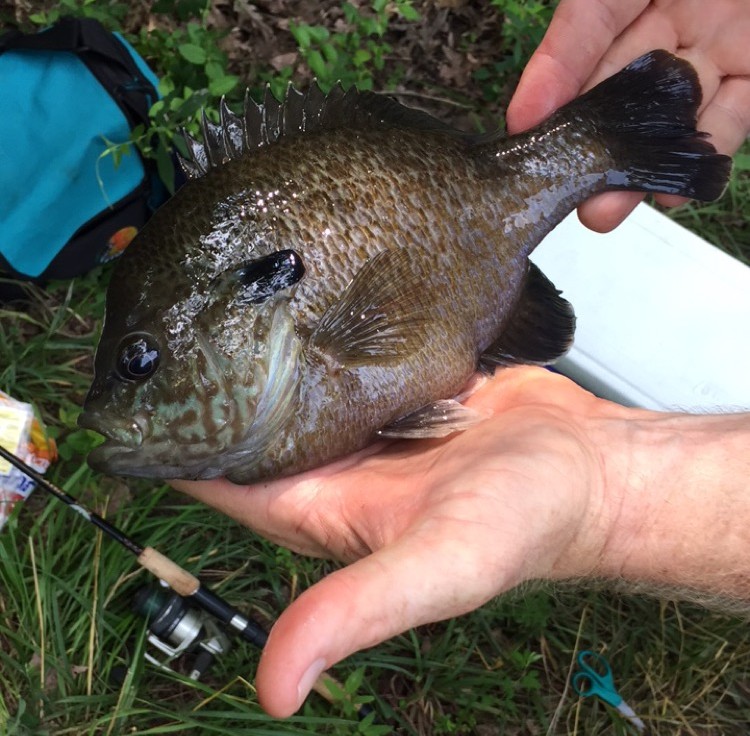
I was thinking about all that moon information (There is a ton more at almanac.com and earthsky.org.) because I have always told people that the best time to go fishing for big bluegill is as close to the full moon in May as you can get. This year we have two chances to try to hit it just right.
The reality is that anytime you can go fishing is the best time to try your luck. My full moon advice has served me well, but weather conditions, water temperature, and hours of sunlight are probably more likely indicators for stringer success. Those atmospheric measurements in Missouri can be dramatically different between May 1 and May 31.
Bluegill and their redear cousins are my favorite piscatorial pursuits. They are most people’s first-fish because they can be easy to catch, but landing large sunfish on Missouri’s lakes and ponds takes some extra focus and a few equipment tweaks. Obviously, big is a relative term; any fish over 8 inches or 12 ounces is a true keeper.
Live bait is usually the best bet with worms and meal worms as the most popular options. I prefer crickets, but they can be hard to find sometimes. Catching fish on artificial flies, spinners, and prepared soft baits can be a blast, but real food always seems to be the best option for bringing bluegill to the dinner table.
Little bobbers are the next big subject to tackle. A small strike indicator is less obtrusive when it splashes in the water and easier for even small fish to pull under. Frequently I see anglers with huge red and white balls attached to their fishing poles. My preference is a thin slip-float that slides along the line until it hits a predetermined stop tied to the line. The pencil shape sinks easily when something takes the bait.
Terminal tackle needs to be small, with a light sinker to match the mini bobber and a hook that can fit in a little mouth. Not trying to get technical, but it’s hard to beat a gold Aberdeen No. 6 hook. I know people who insist that No. 8s are better, (The larger number represents a smaller hook.) but the slightly larger, light-wire hook is easier to remove.
The other instance where size matters is in the line you choose. Modern technology has come to fishing string with a wall-full of options. Nylon, fluorocarbon, and polyethylene braids are all the rage. Some perfectionists suggest that two-pound test or less is preferrable, and the smallest size you can be comfortable with is recommended, but I exclusively fish with four-pound monofilament on my panfish setups.
Where to find fish is the next test. This time of year, they move toward shallow areas for nesting. Expect them in clear water areas near shallow flats along the shoreline. As is the case with all fishing, stealth helps. Find a way to get your bait to those areas without giving up your own location.
Bluegill are found naturally in streams and lakes statewide and stocked in just about every man-made pond. In places where there are not enough predators, the sunfish can become stunted, but in bodies of water with an overabundance of bass, big bluegill are usually the standard.
Bringing the right equipment to the right place will always do more to affect fishing success than the moon, so when you gear up make sure you size down. And that’s the name of that tune.
John Winkelman has been writing about outdoors news and issues in Jefferson County for more than 30 years and was the Associate Editor for Outdoor Guide Magazine.

