Festus fisherman lands new world record bighead carp

George Chance of Festus was fishing for catfish in the Mississippi River when he landed in the world record book for catching a 97-pound bighead carp.

“The good Lord is looking down on me.” George Chance was not talking about the world record fish he caught, but all the glories of his 78-plus years on earth. The retiree said he goes fishing at least three days a week at one of the several spots he has permission to fish near his Festus home.

“If it was a drug, you could say I was addicted. I have three or four lakes or creeks that are no more than 10 minutes from the house,” Chance said. “I tell my wife, ‘If they’re not biting I’ll be back in an hour or so. If they’re hitting, I’ll call and let you know when I’ll be home.’ I’m liable to be there until dark.”

He was fishing for catfish on the Mississippi River just north of Truman Access when he hooked the new world record bighead carp on March 19. After 20 minutes of fighting to get the fish reeled in, he said the real struggle came when he had to get the 90-pounder up the river bank and into his truck.

“When I got him far enough up on the bank where he couldn’t flop back in, I looked up the state record up on my phone,” Chance said. “I wasn’t sure what kind of carp it was, but the state records were 60, 70 and 80 pounds. I estimated it to be in that range.”

So he drove to the Bloomsdale Recycling Center, where he knew they had a big scale to weigh the fish, and it registered at 98 pounds. He called Jefferson County conservation agent Ben Bardot who met him there.

“I was impressed. He was there in a half hour,” Chance said. “He certified the scale, the weight and certified that it was a bighead carp. He said, ‘George you’ve got a state record here.’”

Bardot explained that in a few weeks Chance would receive a plaque acknowledging his state record catch. The next day he said he received a call from the state Department of Conservation to tell him that his fish qualified as the new world record for pole-and-line fishermen.

Officially the new record is 97 pounds. Chance’s fish broke the previous state record of 80 pounds and the world record of 90 pounds. He said he was hoping to catch something big, but he wasn’t expecting a carp or a record.

“I don’t eat catfish, but I have friends who are lined up to get them if I catch some. I like to hang into a 20- or 30- or 40-pound flathead or blue catfish,” Chance said. “I have pictures of me with 40- and 50-pound catfish.”

He was fishing with 50-pound test line and had his reel set to 30 pounds of drag, he said. He was using a modified crankbait, bouncing the lure along the river bottom when he hooked the carp.

“You can tell what a fish is once you hook into it based on how it fights,” Chance said. “At first it was moving pretty slow, and I thought it could be a flathead. Then it took off fast and stripped line off my reel like it was an ultralight. Over the next 20 minutes, it kept taking less and less line. By the time I got him in, he had pretty much given up.”

Chance said he removes the front treble hooks from the deep-diving crankbaits he uses, leaving only the tail hook. The missing hooks do not limit he catches he says, and it almost completely eliminates snags.

“If the lip gets hung up, you can usually give it some slack, and it will float back out,” Chance said. “I don’t lose many lures.”

The bighead carp is one of several invasive species in Missouri, and anglers are encouraged to harvest them when they can.

“I chopped up the fish and put it in my garden,” Chance said. “I’m going to eat it in the form of tomatoes and cucumbers.”

Missouri state records are recognized in pole-and-line and other methods categories. The state record big head carp taken by bowfishing weighed 125 pounds, 5 ounces, and was caught at Lake Perry in 2021.

Periodical cicada invasion should be celebrated

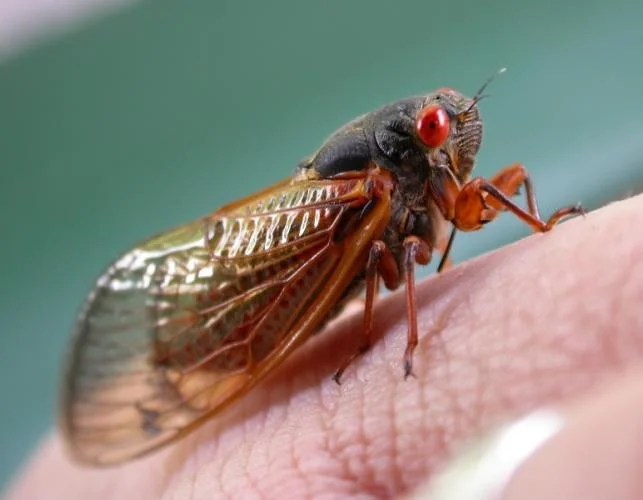
Periodical cicada will emerge this spring, but rather than fret, we should celebrate the phenomenon and pray that we will be around to complain when their offspring return in 13 years. Missouri Department of Conservation photo.

For several weeks social media reactionaries have been hearkening the end of times with near Biblical fervor. It’s not a plague of locusts, but a measurable oddity that manifests from time to time in the form of periodical cicadas.

Yes, hordes of noisy bugs with sometimes marginal aviation skills are due to return this spring to most of Missouri, including Jefferson County. And while it is a fact that two separate North American broods are due in 2024, they do not have any overlapping areas in our vicinity. So all the bluster about a double whammy are sensationally over-rated.

Because of the widespread nature of the world wide web, and the trends of modern media to make scary mountains out of skimpy mole hills, many people are nonplussed to near frenzy. Their memories of gigantic creatures filling the skies like hard shelled confetti during previous invasions are certainly compromised by the passage of time. In this case, exactly 13 years.

The overlapping emergence of two separate broods of periodical cicadas will only occur in a few counties in central Illinois

To get started we have to crunch some numbers. With apologies to entomologist Charles Marlatt who designated the different broods 130 years ago, I am disregarding his affinity for Roman numerals. The figures are tricky enough without complicating things with Is, Vs and Xs.

Brood No. 19 is a group of 13-year cicadas that reappear throughout Missouri, and in significant portions of Illinois and Arkansas. Known as the Great Southern Brood, they also pop up sporadically across the southeast United States. What we will hear and see this spring are the offspring of cicadas that emerged in 2011.

Also appearing this year will be Brood No. 13, a group of 17-year cicadas with a range that covers northern Illinois, eastern Iowa, southern Wisconsin and smidgens of Indiana and Michigan. While the two groups have some overlapping areas in central Illinois, compared to the entirety of the range the double-emergent locations are minuscule.

In years when two broods coincide we are treated to headlines for “a once in a life-time occurrence.” Each 13-year brood matches up with a 17-year emergence every 221 years, so the last time that No. 13 and No. 19 were in-sync was 1803. The overall number of broods complicates the rarity claims.

Those of us who know our memories don’t go back to Thomas Jefferson’s administration may recall 1998 when our 13-year No. 19s matched up with the 17-year Brood No. 4 in northwest Missouri and neighboring states to the west. Half of those bugs were in the news again in 2015 when the No. 4s reemerged during the same season that the 13-year No. 23 Brood found its way up from the earth in the Missouri Bootheel region.

These big bugs will be good news for hungry fish and wild turkeys. Missouri Department of Conservation photo

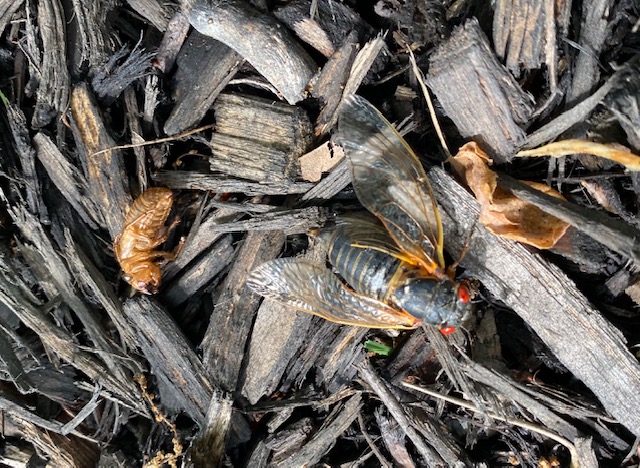
According to the state Department of Conservation, periodical cicada nymphs crawl out of holes in the ground as temperatures warm in late April. By early May they have attached themselves to tree trunks and other structures, abandoning their exoskeleton shells, unfurling new wings and taking flight.

Males spend the next several weeks “singing” to attract females in a high-pitched droning noise. After mating, the females lay their eggs in small slits they cut into tree branches. Once the eggs hatch, tiny cicada offspring fall to the earth and dig in to wait for their emergence in 13 or 17 years.

The slow-moving nymphs and short-lived adults provide a smorgasbord for birds and fish. The massive numbers of them hatching in a short amount of time are their defense against so many potential predators.

I first heard about this year’s emergence from Ozark Smallmouth Alliance founder and big bass bug fly-tier Ryan Walker who was busy creating lures to “match the hatch” this summer. While they may be noisy and their shells and carcasses abundant, they also signal a good opportunity to feed the fish and fatten our wild turkeys.

Missouri is home to annual “dog day” cicadas that appear from late June into August. While similar in habits and habitat, those bugs are bigger and not as abundant each year.

It’s going to be noisy for a few weeks, but cicadas cause no harm to people and do minimal damage to trees that host their egg-laying activities. It’s a small price to pay to experience an interesting natural phenomenon. We should all just hope and pray to be around to complain when our No. 19s return in 2037, in the same year as Brood No. 9, for the first time in 221 years.

Pending legislation needs support to curb Callery pear tree spread

Frequently I hear people talk about “cutting Callerys,” but I am always disappointed to realize they are saying calories and not the generic name for those nasty Bradford pear trees that are out in full force again this spring.

Open ground along the interstates and other roadways are choked with invasive plants like Callery pear trees and honeysuckle bushes, crowding out native species of plants.

Any spring driving trip near a populated area shows that the invasive species is proliferating. It is particularly disheartening to see roadside subdivisions populated with the popular landscape tree, and hundreds of the white fluff balls growing wild in nearby rights-of-way, eliminating opportunities for native plants.

Fortunately there are a couple of strong efforts to turn the tide. The most certain step in the right direction is a “buyback” program coordinated by the state Department of Conservation in partnership with the Missouri Invasive Plat Council, Forest ReLeaf of Missouri, and the Forrest Keeling Nursery.

State residents who remove a Callery pear tree from their property can receive a free native tree from a participating nursery on April 23. Participants must register before April 15 and provide a photo of the tree they eliminated. For more information and registration, visit moinvasives.org.

Callery pear tree flowers may look pretty in the spring, but they are actually pretty destructive, spreading the invasive species.

The other positive step to curb the incursion is beginning to make progress in the state legislature. House Bill 2412 has passed from committee to the floor of the House of Representatives for a potential vote. The companion Senate Bill 1281 is awaiting committee approval. Contact your local representative and ask them to support the legislation.

The proposal would prohibit the sale of Callery pear trees, Japanese honeysuckle, winter creeper, burning bush, and sericea lespedeza. Those five represent the worst of more than 140 invasive plants known in the state, according to the Missouri Invasive Plant Council.

“If passed, enforcement may take effect January 1, 2026, with the exception that burning bush and Callery pear plants acquired by a licensed Missouri wholesale or retail plant nursery before January 1, 2025, would be exempt from enforcement until January 1, 2028,” the council’s website states. “This bill is not intended to put any plant grower or seller out of business.”

Opponents of the legislation say it restricts personal freedom for landowners to plant what they want, but it is even more of an infringement the rights of neighboring property owners where the invasive species spread, causing expensive control measures, and threats to livestock, wildlife, forest products and outdoor recreation industries.

According to a press release from the conservation department, the Callery pear rose to fame in the 1960s as a popular ornamental landscape tree.

“This tree species became popular because it was inexpensive, it grew quickly, and provided showy white blooms in the spring,” said Russell Hinnah, a state forestry supervisor. “But the bad outweighs the good. Different varieties of the tree were planted close to each other, resulting in cross-pollination and spreading the tree nearly everywhere.”

The ability for Callery pear trees to cross-pollinate is why many roadsides, rights-of-way, parks, and other natural areas are filled with more white blooms every spring. They quickly invade open areas and crowd out native plants.

The trees are known for their stinky smell, and their poor branch structure, often losing limbs or splitting apart in severe weather.

“The best decision is to plant a tree species native to Missouri, and there are many great substitutions,” Hinnah said. “Serviceberry trees grow similar white blooms in the spring, and they have small red fruits that attract wildlife.”

Other alternatives include hawthorn, eastern redbud, and Missouri’s state tree, the flowering dogwood. Hawthorns provide bountiful fruit and attractive fall color, while dogwoods thrive in shady areas, but can be difficult to grow.

Learn more about native trees and landscaping online at mdc.mo.gov.

Leap year delays opening day at Missouri trout parks

The concept and calculations for leap day and leap year are quite simple, but the schedule has always been a question in my mind. I understand that it takes 365 days and six hours for the earth to complete a full trip around the sun, but why in the world would anyone choose to make February longer?

Personally, I’m fond of February since it’s my birth month, and I’m a fan of its focus on Black history and heart health. Still, it has never made sense to me, or anyone else I’m sure, why it has an inconsistent number of days with all the other months every year, and it gets the extra day once every four.

Doesn’t it seem logical that the calendar should have been created with simple math in mind? Seven months with 30 days and five with 31 adds up to 365. Then every year you could add the bonus day at a more favorable time of year like May or June. Having a September 31 would seemingly extend summer for one extra sunset.

As many as 10,000 anglers are expected at Missouri’s four trout parks for opening weekend beginning March 1.

The real complication with the current system is that it delays opening day of trout fishing season in the state’s parks by 24 hours. Friday, March 1, is opening day for trout fishing in the four parks in Missouri that cater to those who love catching the cold water species.

The state Department of Conservation operates hatcheries at all four parks and stocks the streams with rainbow trout daily while the season is open through Oct. 31. The weekend opening could bring about 10,000 anglers to the streams depending on the weather. There will be big crowds no matter what, but a warm and sunny Saturday and Sunday will pack the places.

The proceeds from the daily trout tags – and annual trout fishing permits for fishing outside the parks – help to fund the hatcheries, which stock about 800,000 fish in the trout parks throughout the year and about 1.5 million trout statewide with the winter Urban Fishing Program and supplementing fish in natural, cold water streams.

The closest park to Jefferson County is Maramec Spring near St. James. The park is owned and operated by the James Foundation, but the conservation department hatchery provides the fish. Bennett Spring, Montauk and Roaring River are in state parks operated by the Department of Natural Resources.

The required daily “trout tag” is $5 for adults and $3 for anglers 15 years old or younger. The limit is four rainbow or brown trout combined. In addition to the daily tag, a Missouri fishing permit is required for residents ages 16 through 64, and for non-residents 16 or older. The annual fishing permit is $13 for state residents, and the non-resident fishing license for the year is $51. Those prices reflect increases approved by the state Conservation Commission at its September meeting and are effective beginning Feb. 29. The new permit costs are up about $1 across the board, and mark the first price hike in 20 years.

Other price increases hunters and anglers will be paying this year include a bump from $17 to $18 for resident spring turkey hunting permits and the any-deer firearms hunting permit. Extra antlerless-only deer tags will be $7.50 this fall, up from $7.

Hunters and anglers under age 16 and 65 or older remain exempt from purchasing annual small game hunting or fishing permits. Daily trout tags and annual trout permits are still required for all ages.

Missouri hunting and fishing permits are valid through the last day of February each year, so 2023 tags are good for one extra day this year, but when March 1 rolls around, 2024 fishing licenses are required. The permits are available at many retail vendors, online or through the state’s Mo Hunting and Mo Fishing apps.

Antler scoring event returns to Henges Center near Eureka

Unfortunately I do not have a good reason to visit one of my favorite winter events this weekend near Eureka, but because hunters in Missouri set a new all-time record for deer harvest in the 2023-24 season, the annual Deer Antler Scoring Open House could be busy.

From 9 a.m. to noon on Saturday, Feb. 17, at the Jay Henges Shooting Range and Outdoor Education Center, hunters can get official measurements for the bucks they took this past fall. Scorers will also consider deer from previous years and shed antlers found at any time.

When the harvest totals of all hunting seasons combined were released in January, the state Department of Conservation announced a new record with 326,026 deer checked. The previous record was 325,457 in 2006. Of the total, 147,705 were antlered bucks, the most bucks ever.

That number includes a significant percentage of young bucks for sure, but there are also plenty of hunters who took trophies this year. There is no cost for having antlers scored, and reservations are not required.

Conservation department education supervisor Jake Hindman measures a mounted deer rack at the Henges Outdoor Education Center near Eureka.

The event will include certified scorers from Pope and Young, Boone and Crocket, and Missouri Show-Me Big Bucks Club. Those organizations maintain record books and charge fees for inclusion. The Boone and Crocket registry includes deer taken with firearms, while the Pope and Young provides the same kind of certification for bow and arrow hunters. Show-Me Big Bucks Club recognizes trophy white-tailed deer harvested or found in Missouri, in typical and non-typical categories. The club also recognizes shed antlers.

Hunters who can not attend Saturday morning, may drop off their antlers at the education center to be scored and then pick them up later. The Henges Range and Education Center is at 1100 Antire Road, at Interstate 44, east of Eureka. For more information call 636-938-9548.

Back to the harvest totals from the recent season. Jefferson County held on to its spot as the top harvest county for archery hunters for the 12th year in a row. Preliminary information from the conservation department showed that hunters checked 55,396 deer during the 2023-2024 archery deer season. Top counties for the archery deer season were Jefferson with 1,440, Franklin with 1,194, and St. Louis with 1,022. Hunters checked 56,683 deer last year during archery deer season.

The biggest difference this year in the overall harvest total is the increase in antlerless deer. According to conservation department, this year was the first since 2013 that more does were harvested than antlered bucks.

“With deer numbers increasing in most counties, additional antlerless deer harvest is needed to slow population growth and help maintain deer numbers at desired levels,” said Jason Isabelle, program supervisor. “It was great to see hunters take advantage of the additional hunting opportunities.”

Regulation changes this year added a new early antlerless firearms portion, a new chronic wasting disease (CWD) firearms portion, and an increase in the number of firearms antlerless deer hunting permits in most counties.

“It’s nice to see the much-needed increase in antlerless harvest given our desire to slow the growth of the increasing deer population to maintain deer numbers at socially acceptable levels,” Isabelle said. “Hunters play a major role in helping to manage CWD and increasing the harvest of both bucks and antlerless deer in the CWD Management Zone will help reduce the spread of the disease.”

The other standout statistic from the season was the report of only one non-fatal, archery-related deer hunting incident and zero firearms-related hunting incidents.

Originally published by Leader Publications of Jefferson County on Feb. 15, 2024.

Unplugged organization continues its work to get kids outdoors

For nearly a decade Missouri Kids Unplugged has been helping young people disconnect by inviting them to explore the outdoors at the organization’s facility near Dittmer and at special events throughout the St. Louis region.

A Jefferson County non-profit works to get kids away from their electronics to learn that crappie are better than computers.

Sunfish are better than screen time; catching crappie kicks computer games; a lake shoreline is superior to social media. Tony Krieg founded the organization in 2015 to provide parents a helping hand in getting their children off of the couch and away from their devices long enough to get hooked on fun outside.

“My favorite success stories are having young adults coming up to me saying that they caught their first fish at our farm six, seven, eight or nine years ago, and that because of that experience they have continued fishing as a favorite hobby,” Krieg said.

The 167-acre property on state Highway B between Hillsboro and Cedar Hill includes three lakes and a pond. Events held throughout the year include Family Fishing Days, recycling education, outdoor crafts programs in cooperation with Home Depot, a hot air balloon glow in the fall, and plans for solar eclipse viewing this spring.

“At our family fishing days we get to see so many first-time fishermen catch their first fish. The day is filled with smiles and squeals of excitement,” Kreig said. He estimated that about 1,000 people visit the farm for fishing and fun each year, plus they encounter thousands more at events they participate in with their partner organizations to emphasize the importance of electronic recycling and getting kids outdoors.

The annual event this time of year is an auction that raises funds to support the not-for-profit throughout the year. Scheduled for February 10, the event is sold out.

“It’s one of the events that allows us to fund all of our programs for free,” Kreig said. “We will have a casino night sponsored by Express Mart on May 10th, and we will be working with First State Community Bank offering an electronics recycling day on April 18th that proceeds will help fund our programs.”

Proper recycling for computers, television, and other devices with a power cord or that operate with battery power is central to the Missouri Kids Unplugged story. It continues to be a point of emphasis for the organization, with proceeds benefiting the outdoor activities for kids.

“I owned an electronics recycling business for years. We connect our passion for proper recycling of these items to fishing,” Krieg said. “We utilize any funds we get from the recycling to fund our free programs to the public.”

The most popular event at the farm is a balloon glow, which attracted more than 400 people for its second annual iteration in October. Visitors were asked to bring non-perishable food items for the Peace Pantry in Dittmer and any small electronics for recycling like telephones, and laptop computers.

Volunteers help make the events successful and many helping hands make the work fun.

“We are always looking for helpers to prep for events and help during our activity days,” Krieg said. “We have people to help kids build a tool box or bird house or help taking fish off a hook.”

For more information about the organization visit missourikidsunplugged.org or follow the group’s Facebook page for regular updates on events and activities.

State plans classes for beginners to learn about hunting and fishing

People regularly ask me, “Where can I go fishing?” and “How can I learn more?” Jefferson County has a few public fishing lakes in city parks and several stream access points along its creeks and rivers.

In my experience, those options offer limited success for bank anglers, except for during and immediately after the park ponds are stocked for special fishing events. Boaters who can get up or down stream from the boat ramps have much better luck than those restricted to the immediate vicinity.

My best advice for finding good places to fish is to make friends with someone who has a pond on their property or access to a subdivision lake. Those locations usually provide the best opportunities for fish catching. (Fishing is easy; it’s the catching part that can be trickier.)

Jefferson County conservation agent Lexis Wilson assists a young angler at a Learn to Fish program.

For the “how to” question, the state Department of Conservation has implemented a new plan to provide classes throughout 2024 for individuals and families in the St. Louis region to learn more about fishing, hunting and shooting sports.

“Our St. Louis Education team is excited to highlight programs each month for 2024 on hunting, shooting and angling,” said Jake Hindman, education supervisor for the area including Jefferson County. “While these programs are designed for beginners and will be introductory in nature, anyone is welcome to attend.”

The conservation department supplies all needed equipment for each program. Beginning anglers will get the chance to discover the art of casting for trout, sunfish, bass and catfish, or learn about kayak and flyfishing options. Classes for those interested in shooting sports will include handguns, modern rifles, shotguns, basic firearm care, and archery.

In January classes featured Backyard Bass Fishing at the Forest Park Hatchery in St. Louis and winter trout fishing information at Powder Valley Conservation Nature Center in Kirkwood. Shooting and hunting classes were held at the August A. Busch Memorial Conservation Area in St. Charles County, and Jay Henges Shooting Range and Outdoor Education Center near Eureka.

The “A Year of New Beginnings in Hunting, Angling and Shooting” series of classes are all free but do require advanced registration online. To review upcoming programs and events in the St. Louis region, go to http://short.mdc.mo.gov/4sg.

Fishing classes planned for February include an Introduction to Fly Fishing from 9 a.m. to noon on Saturday, Feb. 3, at the Busch Conservation Area. Held at Lake 2, participants will learn fly-fishing rods, reels, line, leaders knots and basic casting.

The All About Trout class is taught in two separate lessons from 8 to 10 a.m. on Feb. 10 and Feb. 11 at the Forest Park Hatchery. Budding anglers will use ultralight spinning reels and rods. Anglers will be trying their luck, so warm clothes and a fishing license are required. The same two introductory trout fishing lessons will be taught together from 7 a.m. to noon on Feb. 14.

For those who would prefer an indoor activity this time of year, three consecutive, 30-minute equipment maintenance virtual programs are scheduled online from 9:30 a.m. to noon on Friday, Feb. 16. Instruction will focus on spinning reels at 9:30, bait-casting reels at 10:30, and fishing rods at 11:30. Webex links will be emailed to participants the day before the classes.

Beginners who would like to try their hands at tying their own flies for fishing can register for a two-hour workshop from 11 a.m. to 1 p.m. on Friday, Feb. 23, at the St. Louis Regional Office on the Busch Conservation Area. All equipment and materials for tying several types of flies will be provided for free.

Turkey hunting hours extended to sunset on private land

Although it doesn’t feel like spring outside, maybe it would help to at least talk about warmer weather activities. For the first time in years, Missouri is making a significant change in its turkey hunting regulations, including confirmed adjustments in April and proposed modifications for the fall.

To allow hunters to hear about the changes directly from the state Department of Conservation scientists, a free, online program is available at noon on Wednesday, February 7. “MDC Wild Webcast on Talkin’ Turkey” will feature biologist Nick Oakley and habitat initiative coordinator Meagan Duffee-Yates.

Learn about changes to the upcoming spring turkey season at noon on Wednesday, Feb. 7, during a “Wild Webcast on Talkin’ Turkey” from the state Department of Conservation.

The program will include information on hunting regulations changes and discussion about turkey production and harvest trends, brood surveys and research findings, habitat loss, and impacts of weather and predators on turkey numbers. Questions from webcast attendees will be welcomed as time permits.

Advanced registration is not required, so potential participants are asked to simply save the link provided by the conservation department and join the program when it begins. https://mdc.webex.com/mdc/j.php?MTID=m85090423505f6cd4b752e5b00ed6e5c2.

Beginning April 15 and concluding on May 5, turkey hunters on private land will be allowed to hunt from 30 minutes before sunrise until sunset. Previously hunting hours ended at 1 p.m. in the spring for adult hunters. The big distinction is the difference between hunting on private property, or any state or federally owned land where hunters will still be required to put their guns away at 1 p.m.

The conservation department press release indicates that 93% of land in Missouri is privately owned and 88% of the annual spring turkey harvest is on private land. Maintaining shooting hours ending at 1 p.m. on conservation areas and other public property supports afternoon activities by other users on those areas.

The primary goal was to provide additional hunting opportunities.

“Hunter participation and recruitment has been on the decline in Missouri for several years,” Oakley said in the press release. “When surveyed on why hunters aren’t participating, the most common answer is that school or work interferes with getting out into the field. Almost every other state in the Midwest and Southeast moved away from an early afternoon closing time after their turkey populations were restored. Those states have seen increases in hunter participation, sustainable increases in harvest, and stable hunter satisfaction after moving to an all-day season.”

The other specific that shouldn’t cause any confusion but likely will is the daily closing time. Most hunting seasons and the original proposal called hunting until 30 minutes after sunset, but for turkey hunting, shooting hours end when the sun goes down.

The proposed fall hunting season change eliminates the two turkey hunting tags that archers automatically receive with their deer hunting permit and will require hunters to purchase two tags that are valid for either archery or fall firearms hunting seasons. The proposal made no suggestion for eliminating the possibility of hunters taking birds of either sex in the fall.
“While hen harvest is contentious in Missouri, our hen-harvest-rate is low enough that it is not having a negative impact on turkey numbers on a statewide scale,” Oakley said. “That said, at the property level, hen harvest may have some impact on future production.”

A public comment period on the proposed changes to the fall season will be open from Feb. 2 through March 2.

Festus hunter fills one of five elk hunting tags issued in state

A once-in-a-lifetime elk hunt in southeast Missouri was one of several major events for Kelly Reeves of Festus in 2023.

While everyone was cheering in the new year, no one would blame Kelly Reeves for watching the Times Square ball drop with a little bit of melancholy. His 2023 is going to be hard to beat.

Just before Valentine’s Day, he and Emily found out they would be parents for the first time. On Memorial Day weekend he started a project to finish the basement in their Festus home. With the help of his handy father-in-law that project was a few tweaks from finished by the end of the year.

Also in May he applied for a Missouri elk hunting tag, as he had each of the three previous years that the opportunity had been available. With more than 8,500 applicants for five hunting licenses, he was not surprised when he didn’t hear anything from the state Department of Conservation after the drawing was held in July.

When he went online to purchase his archery deer hunting tags on September 14, the afternoon before opening day, he noticed that it showed a drop-down button for an elk hunting license.

“It didn’t make sense that it was available if I hadn’t been drawn. I had never seen that option before. It had to be wrong. They would have contacted me,” Reeves said. He navigated to the department website to check the drawing results, and there alongside his previous years’ rejection notices was the bold “SELECTED” next to 2023. He called the conservation office in Columbia, and they told him a letter had been mailed to him.

Disregarding that miscue, Reeves knew he had work to do with three weeks remaining before the opening of the archery portion of the elk hunting season. He began making contacts near the Peck Ranch Conservation Area where Missouri began restoring elk in 2011. The reintroduction area covers about 200,000 acres and includes parts of Carter, Reynolds and Shannon counties.

Lightly populated and densely wooded with deep ravines and tall Ozark foothills, the land is the best place in the state to bring back a species that had been extirpated by unregulated hunting in the 1800s. It is also a place with very little cell phone service. So after a long day of research and scouting on September 25, Reeves was on his way back home when his truck reached a high spot on the highway.

“My phone started blowing up. I had nine missed calls from Emily and texts from her and her sister. She was at 38 weeks, and her blood pressure was spiking,” Reeves said. He made the two-hour drive in much less time than normal.

They arrived at Mercy Hospital St. Louis before midnight and within minutes they were in a labor and delivery room. About 33 hours later, he was there when the doctor asked him if he wanted to assist in the birth of Lucy Lu.

“That was by far the best part of my year,” he said.

Hunters drawn for an elk tag are allowed to participate in a nine-day archery hunt in October and a nine-day firearms hunt in December. Reeves managed to make two more scouting trips before the archery season. He said he heard bull elk bugling more than 100 times on opening day, and called in a six-by-six that may have been close enough for a shot, but the season was early. A better opportunity was sure to come, but the weather turned unseasonably warm for the rest of the season.

“The elk disappeared,” he said. “I joked to my hunting buddies they all found a cool cave underground and were hiding. I ended up putting 500 miles on my truck driving the dirt and gravel roads searching for new elk and about 10 miles on my boots, looking high and low. No luck.”

He returned for the firearms portion of the season and on opening morning he spotted a herd of elk in a field on the public land he planned to hunt. It was still dark when they set up, but they may have been noticed by a couple of the cows. The bull and his harem worked their way onto the woods. Climbing in the hill to follow them or looking for an ambush spot, risked driving the herd away. The best strategy was to hope they would return to the field in the evening

“It was 7:30 a.m., and we were already done for the day. We made a plan to be back in the blind by 2 p.m.,” Reeves said.

The weather was in the 50s when they set up the blind, but a cold front was due overnight. The wind was gusting to the point that it pulled up the anchor pegs on their tent-like structure, so Reeves and his companion had to replace the ground stakes. As he returned to his stool, Reeves noticed a cow entering the field, then another, then he spotted the bull they had nick-named Medusa for its non-typical antlers that went in all directions like the mythical serpent hair.

The big elk was more than 300 yards away, so Reeves crawled out of the blind to take the shot from a prone position with his gun propped on a hunting backpack for stability. With practice at distances of 100, 200, 300 and 400 yards at the Arnold Rifle and Pistol Club, Reeves was confident in his shot placement. As he squeezed the trigger, he watched the bull fall through his scope.

“I didn’t do anything to deserve this tag. I was just really lucky this year.”

Originally published by Leader Publications of Jefferson County on January 4, 2024.

Experience is the best teacher for deer hunting

A few weeks ago the state Department of Conservation planned a beginner’s seminar for deer hunting, and while I don’t qualify as a novice, I am not an expert by any means. Still, my first reaction was, “could I teach a class on the subject?”

I’m not volunteering and do not have the credentials, but with more than 30 years experience I believe I could create a fair curriculum for Deer Hunting 101.

The first session would be on rules and regulations. Hunter safety education is required for purchase of a permit, and signing your permit is a contract that says you agree to abide by the Wildlife Code. The required text would be the updated regulations booklet published each July by the department.

Motion-detection trail cameras can provide insight on deer numbers and movement in an area you plan to hunt.

Selecting a firearm for the job is a matter of personal preference. Every hunter has his or her own favorite that they swear by and sometimes swear at. Most modern center-fire rifles shoot nearly flat well beyond a 100 yards, but newbies should stick to shorter shots. Patiently waiting for a deer to come into your proximity is the best bet.

Telescopic scopes that most guns come equipped with can be dialed in precisely for anyone to use, but a new hunter must shoot the rifle in advance to get a feel for its weight (they’re heavy), recoil (they kick) and report (they’re loud). All hunters regardless of experience level should send a few rounds down range prior to each season to refamiliarize themselves with the gun they plan to shoot when it counts.

New hunters who want to take up archery have to spend much more time getting acquainted with their bows. The repetition and muscle memory needed for accurately launching arrows requires dedicated practice to hit a stationary target. The pressure of placing a perfect shot when buck fever causes a racing heart and shallow breathing can only be overcome by confidence.

The last bit of advanced preparation is to learn all you can about the property where you hunt. Deer are just about everywhere in the state, but knowing the areas they are most likely to use during the season is a step toward success. Preseason walks in the woods, and motion-detection trail cameras can provide needed reconnaissance.

Where to hunt is also a bit of personal style. Many stands are set up near big fields. It seems logical because when you drive by you can see herds of deer in the open areas morning and evening. Deer do get killed in fields, but my response is always, “for every one you see standing exposed, there are a dozen hidden in the surrounding woods.”

You can not see as far in the forest, and many deer will pass undetected, but that’s where they live. They browse on grass and other greens or grains, but they eat acorns in the fall, and they find them among the trees. This time of year they have other deer on their minds, and again, there are many more in the woods.

Finding the best ambush point is the next consideration. I have hunted from ground blinds and elevated stands, and the view from above is significantly longer and clearer. Being 15 feet off the ground has added potential danger, so I would emphasize safety again. If you don’t have a fall-restraint system, you should stay on the ground.

It is less likely for the deer to see the hunter in a tree stand, but that doesn’t mean they won’t spot trouble above their heads. The most important piece of advice matches what I think has always been my best asset as a hunter. I can sit on my butt for a long time. Staying quiet and still while remaining vigilant for any movement or unusual noises is the key strategy.

Almost every noise you hear is going to be a squirrel, and every movement a falling leaf or flitting bird, but you have to check each out carefully. One of those times it will be the flick of a deer tail or the crunch of a hoof.

When that deer is in sight and in range, you return to the basics of hunter safety education and the importance of positively identifying your target and knowing what lies beyond. Success is the reward for a hunter’s patience, but hunting safely is what makes it a lifetime of fun.

What to do after you take the shot is full course itself. “After you pull the trigger, that’s when the real work starts.”

Originally published by Leader Publications of Jefferson County on Oct. 19, 2023. John Winkelman has been writing about outdoors news and issues in Jefferson County for more than 30 years and is the Associate Editor for Outdoor Guide Magazine.