Jefferson County and its neighbors continue to rack up substantial increases in cases of chronic wasting disease discovered in deer harvested by hunters. After increasing its total by more that 50% last year, Jefferson recorded an increased number of cases again this year, according to an annual report issued by the state Department of Conservation.
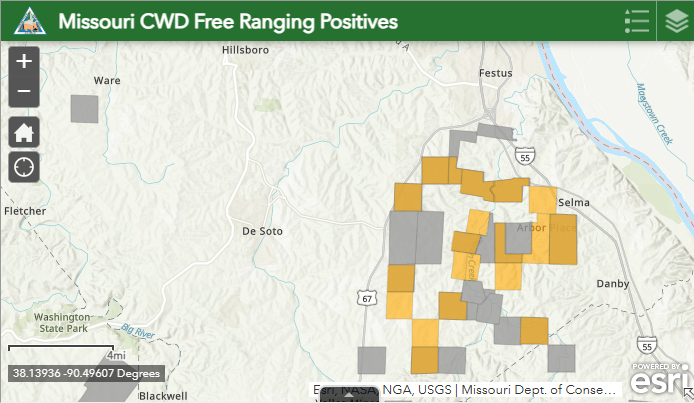
The 17 new positive tests from the 2024-25 season in Jefferson County tops the 2023-24 total of 15, and moves the county’s overall total to 60 since the first case was discovered near the Meert Tree Farm south of Festus in 2016. Fifty-nine of those confirmed positive tests have been from property within a five-mile radius of the original site.
Since 2016, hunters throughout Jefferson County have been required to get the deer they kill on opening weekend tested for CWD. Only one positive test has been found beyond the triangle formed by Interstate 55, Highway 67 and the Ste. Genevieve County line. Hundreds of deer have been tested from outside of that concentrated area, and the only outlier is a positive test from near Ware in west central Jefferson County in 2023.
While the disease does not appear to have spread its tentacles across the county, it continues to rapidly expand its range statewide. Seven counties had their first cases discovered this year including some heavy hitters in annual harvest totals. Texas County in south central Missouri is routinely in the top 10, and Callaway County between St. Louis and Columbia posts big numbers for archery and firearms harvests.

In 2011 CWD was discovered in wild deer in Macon County, Missouri, near its border with Linn County. Those two counties combine for 156 of the 815 positive cases statewide. With 34 new positives this year, Ste. Geneveive County has the highest individual county total in the state with 136 cases. Franklin County added 24 new cases this year to reach 99 since the disease was first discovered there in 2015.
The annual information release reported 243 positive tests gleaned from more than 36,000 samples taken from 276,000 deer killed in fall firearms and archery seasons, and from post-season targeted removal on properties where the disease has been found in the past. Seventy of the positive tests were from 4,768 deer harvested statewide in post-season effort.
“The goal of targeted removal is to remove CWD-positive deer and reduce deer density in these localized areas to slow the spread of CWD and protect Missouri’s deer herd,” said Deb Hudman, state wildlife health program supervisor. “Targeted removal is a proven method to slow the spread of CWD, and Missouri is one of several states that uses it to manage the disease.”
A positive test rate of less than one percent is good news and a sign that the program to limit the spread is working.
Texas, Callaway, Marion, Miller and Morgan counties, which found their first positive test results in 2024-25 will be included in CWD-management zones when the Conservation Commission meets this month to establish regulations for the upcoming fall seasons. Because of the location of the positive test in Marion County, Ralls County is likely to be added for management zone regulations as well.
Hunters in those counties should expect to be required to get any deer they kill during opening weekend tested for the disease, and hunters will be permitted to hunt through the extended CWD season, which follows the November portion through Thanksgiving weekend. Providing grain, salt, minerals or other consumables for deer will be prohibited year-round in those areas.
Full details on the fall hunting season will be released in July with the publication of the annual Fall Deer and Turkey Huntoing Regulations booklet. To see full information on chronic wasting disease in Missouri visit www.mdc.mo.gov/cwd.
John Winkelman has been writing about outdoors news and issues in Jefferson County for more than 30 years and was the Associate Editor for Outdoor Guide Magazine.







 Don't Call Me Outdoor John