My grandma Loretta Nahlik made meals for 13 kids and 57 grandchildren. She also fed the dogs, a barnful of cats and countless chickens over the years. We humans tried to return the level of love she showed; the dogs provided protection, or at least a warning bark; the cats kept the mice in check, and she was proud of the egg money her hens offered.
Grandma also fed the birds, but unlike what she got from the rest of us, she never really saw much return on that investment. She enjoyed the birdsong that her feeders attracted and caught glimpses of occasional flits past her windows, but with so many other mouths to feed, she obviously didn’t have much time to watch the feeding frenzy in her front yard.
I think of Grandma often when I fill my feeders, and I find that kind of surprising because it was such a tiny fraction of all that she did for our family and a great community she created at St. John’s Church and through many other organizations.
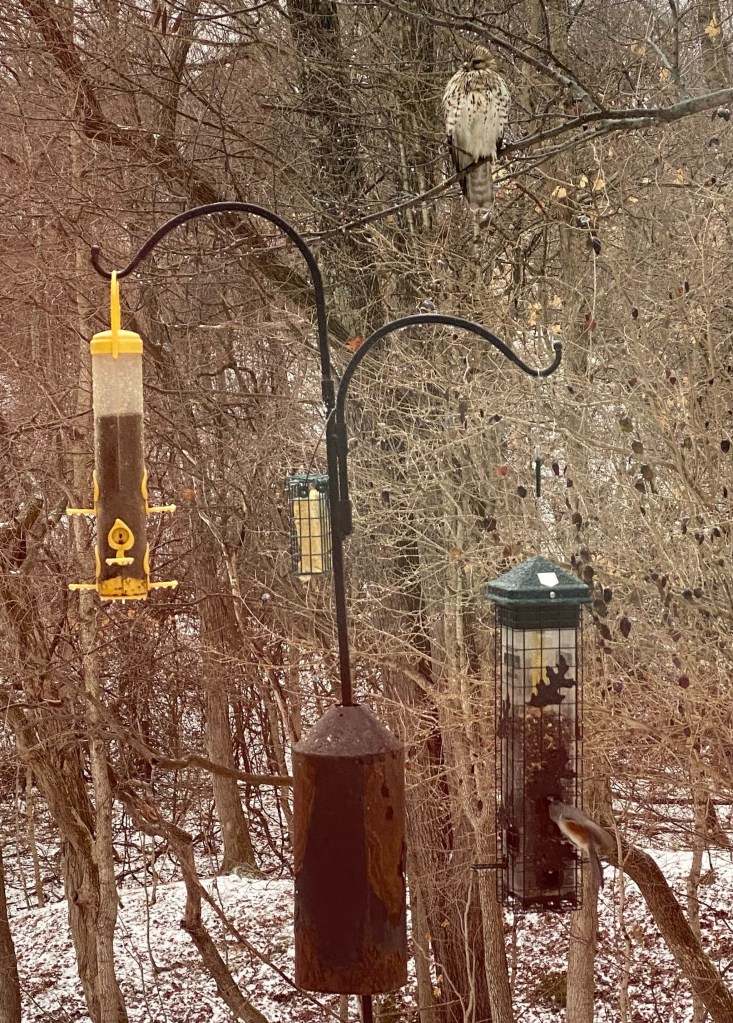
She fed the birds for the sake of the birds, but I keep my feeders filled for me to be able to stand and stare out the window and see who comes to visit. I guess that is what I like so much about Project Feeder Watch. My selfish obsession can be shared as part of a citizen-science effort to provide data on the backyard birds.
This year marks the 40th anniversary for the program through the Cornell Lab of Ornithology and Birds Canada. This is only my second year as a participant, and I was excited to sign up again after I arranged my array of feeders for the fall.
“Feeder Watchers help track population trends and range shifts, monitor avian diseases, and uncover exciting revelations about the day-to-day lives of backyard birds,” the program’s website feederwatch.org states. “Increasingly, the scientists behind Project Feeder Watch are using data collected by participants to learn more about bird-friendly action and what we can all do to help our local birds thrive.”
Registering to participate is even easier than watching the birds, albeit significantly less entertaining. It costs $18 to join the effort, about as much as a big bag of black oil sunflower seeds at your local Buchheit Store. The money is used by the non-profit Cornell Labs and Birds Canada to maintain the website, database and publications.
The next step is to identify your count site and select consecutive days you can monitor the bird activity between November 1 and April 30. Watchers look for every species that can be identified and record the maximum number of individuals visible simultaneously during the two-day count.
I keep a little notebook on the windowsill to make notes. My data from last year is still available for review. I filed nine reports and counted 21 different bird species. The program also collects information on mammals (deer and those dreaded squirrels) at the feeder site, sick birds, and behavioral interactions, including predation.
The information may be submitted through an online form or mobile app. How the observations are entered is not as important as the data itself. Even if it seems like the counts are small or include all the same common birds, their numbers are important.
“While we are all thrilled by unusual sightings and high counts,” feederwatch.org states, “it’s the everyday observations of common birds that are so important for monitoring bird populations.”
Participants receive an online newsletter that includes project updates and reminders. Also included is a full-color poster with common winter birds to help with identification and a calendar that features photographs taken by other Feeder Watchers.
The sustenance provided to birds by the seeds offered through the winter certainly benefits our feathered friends, but it is what can be learned by turning observations into scientific analysis that can make a significant difference.
Grandma may not have had time for that, but I’m certain she is proud that I am doing my part.
John Winkelman has been writing about outdoors news and issues in Jefferson County for more than 35 years and was the Associate Editor for Outdoor Guide Magazine.

