A small segment of Jefferson County is one of eight similar locations in the state serving as pilot programs for the Department of Conservation’s most recent effort to engage hunters, landowners, and the general public in strategies to limit the spread of chronic wasting disease in the Missouri deer herd.
One of the most notable things about Ware, Missouri, is its location on state Highway Y. Grandview High School is obviously the tiny burg’s greatest claim to fame, but its status as the home of the Eagles doesn’t change the fact that it is fun to mention “where on why” any chance you get.
The town in southwest Jefferson County, west of Hillsboro and DeSoto, is also at the center of CWD Core Area 36. The conservation department is working to partner with hunters and landowners through a community approach that uses hunter harvest as the primary tool to manage the deer herd during the regular deer hunting seasons.
Targeted removals in the core areas will not be used this year. The program was suspended last year, and the department currently has no plans to resume the practice, which had been utilized since the deadly disease was initially discovered in wild deer in Missouri in 2012.
During the 2026-27 deer hunting seasons, the department will conduct a Community Deer Management Pilot in eight CWD core areas throughout the state. Those designated areas surround locations within a mile or two of where the disease has been detected. CWD was first detected near Ware in 2023 and a new positive case was discovered in the vicinity in 2025.
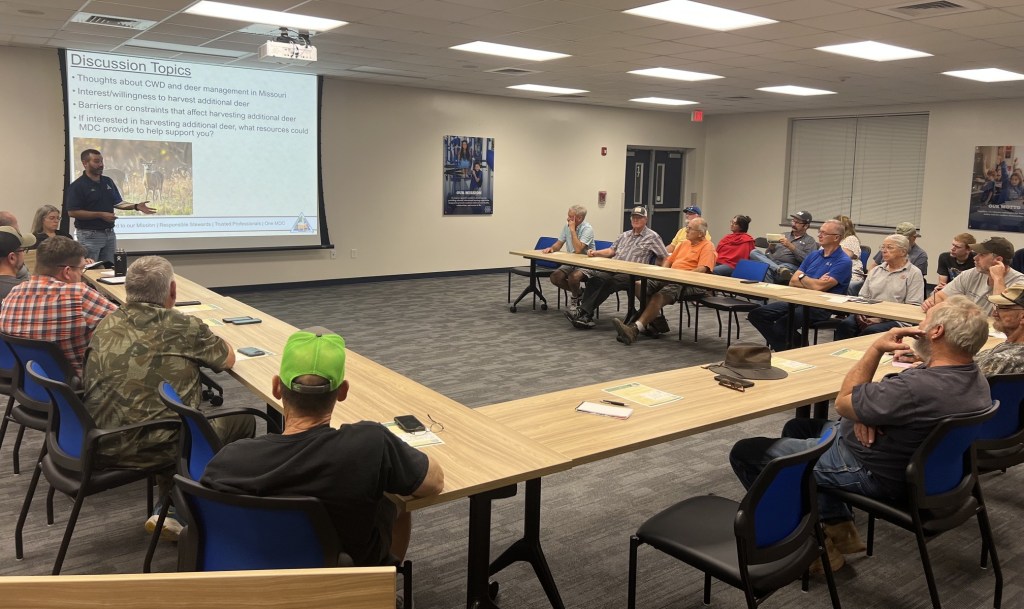
Local landowners and hunters were invited to a meeting on October 1 at Hillsboro Intermediate School for a conversation with conservation representatives led by the department’s program supervisor Jason Isabelle. Following a brief presentation, the group of about 30 area residents were invited to ask questions.
“We are listening. We want to hear from you,” Isabelle said. “You are critical to our success.”
The conservation department is encouraging hunters to harvest additional deer in the core areas where chronic wasting disease has been identified. By increasing deer harvest, the disease will spread less, the herd will be healthier, and quality hunting will be maintained, Isabelle said.
The presentation slide show included data from Wisconsin that showed rapid expansion of the disease when management is limited. The percentage of adult male deer testing positive for the disease increased from 3% in 2002 to 56% in 2017. The disease rate for adult female deer escalated from 1% to 35% over the same period.
In another study conducted by the Wisconsin Department of Natural Resources, live deer were tested for the disease and fitted with GPS tracking devices. Bucks that were not infected with the disease had a 69% annual survival rate, while only 17% of those that were CWD-positive survived for one year. Uninfected does had an 83% survival rate, more than double the 41% rate for CWD-infected female deer.
Within the core areas throughout Missouri landowners with at least 20 contiguous acres can receive up to five no-cost CWD Management permits to use during the hunting season. Those permits may be assigned to anyone with permission to hunt on the property.
Hunters are encouraged, but not required, to have deer taken with management permits tested for the disease. Isabelle said the sampling is not mandatory because the department does not want to limit participation. The U.S. Centers for Disease Control recommends that deer harvested in areas where CWD has been found should be tested before eating the venison.
Core Area 36 near Ware is one of 82 designated locations around the state. It is relatively small, about twice the size of the city of Arnold. All eight of the pilot areas are small in this first year of the program. Isabelle said, one area was selected in each region of the state.
The area of Jefferson County south of Festus with a higher documented prevalence of chronic wasting disease is part of the much larger Core Area 4. It includes almost all southeast Jefferson County, more than half of Ste. Genevieve County, and a significant portion of Perry County. The numbering system for the areas is based on when CWD was first detected, Isabelle said.
“We’ll use what is learned through this year’s pilot to develop a template that can be replicated in other CWD Core Areas in the future,” he said. “This fall’s pilot is in direct response to public feedback we received this spring, and we look forward to partnering on this important effort.”
John Winkelman has been writing about outdoors news and issues in Jefferson County for more than 35 years and was the Associate Editor for Outdoor Guide Magazine.

