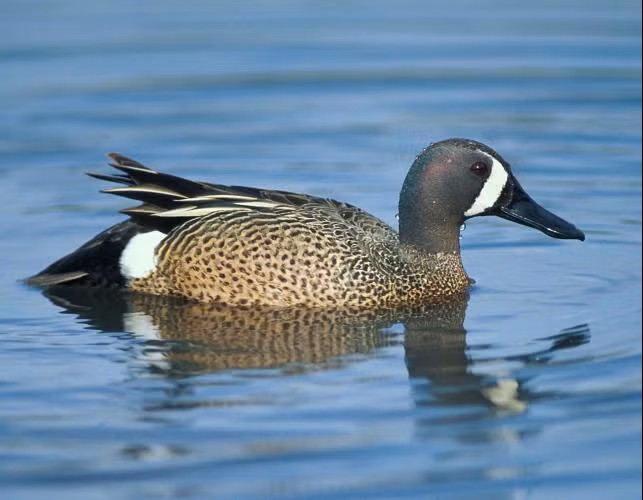
With Sept. 12 as opening day, the blue-winged teal is the first target for waterfowl hunters in Missouri.
Four months of deer hunting season may seem like an eternity, but compared to opportunities for waterfowl shooters, the quest-for-venison calendar looks compact. Teal hunting opens in early September, and the light goose conservation order allows harvest until April 30, 2027, providing nearly eight months of shotgun swinging.
Hunters may take up to six blue, green or cinnamon teal in the aggregate each day during the nine-day season, which is scheduled from Sept. 12 through 20. The length of teal season depends on population surveys from the previous year. In 2025, the breeding population – in Canada, Alaska and the Northern Rocky Mountains – was estimated at 4.4 million. When that number exceeds 4.7 million, the season is 16 days long. If the estimate is fewer than 3.3 million teal, no season is scheduled.
Fast-flying teal are small compared to the other ducks hunters will call this fall. According to the state Department of Conservation field guide, adults are 14 to 16 inches in length. The much more familiar mallard averages about 23 inches from bill to tail.
One distinction for the teal season is that shooting hours are from sunrise to sunset. With the exception of the light goose conservation order next spring, all other waterfowl hunting is permitted from 30 minutes prior to sunrise until sunset.
An early season for Canada Geese and brant is next on the schedule with a nine-day opportunity for hunters to take three Canadas daily from Oct. 3 through 11. The possession limit for Canada Geese and brant is nine.
Youth waterfowl hunting is held on three different weekends depending on location. In the designated North Zone, hunting is scheduled for Oct. 24 and 25. It’s set for Halloween weekend, Oct. 31 and Nov. 2, in the Middle Zone. The dates for the South Zone are Nov. 21 and 22. Hunters aged 15 and under – accompanied by a non-hunting adult at least 18-year-old – may take daily limits of up to six ducks, 15 coots, 20 light geese, three Canada geese, and two white-fronted geese.
All hunters get their chances in three different 60-day seasons based on the area of the state where they will be hunting. Delineated by highways that wend their way near the north bank of the Missouri River, the North Zone is roughly the top third of the state. That season opens Oct. 31 and closes on Dec. 29.
The Middle Zone is the largest and includes all of the Missouri River across the state. In addition to the center section, the zone dips significantly toward the Bootheel. That prime lowland and everything else along the Arkansas border is in the South Zone. Middle Zone hunting days are Nov. 7 through Dec. 13 and Dec. 19 through Jan. 10, 2027. South Zone hunting opens Nov. 26 through 29 and Dec. 7 through Jan. 31, 2027.
The regular season for goose hunting is scheduled to overlap the above duck hunting opportunities from Nov. 11 through Feb. 6, 2027. In addition to Canada Geese and brant, hunters may harvest two white-fronted geese and 20 snow geese daily. The possession limit is three times the daily limit for Canada geese, brant and white-fronted geese. There is no possession limit on snow geese.
The light goose conservation order from Feb. 7 through April 30 is even more liberal in its attempt to manage an exploding population of snow, blue and Ross’s geese. There is no daily limit, and hunting is allowed from 30 minutes before sunrise until 30 minutes after sunset.
Non-toxic shot is required for all waterfowl hunting. Lead pellets have been proven to cause fatal poisoning for birds that ingest the spent shot, as well as the eagles and other carrion predators that eat the dead birds. Federally approved non-toxic shot shells include alloys of bismuth, copper, iron and tungsten.
Three permits are required for waterfowl hunting in Missouri, including a small game hunting license, migratory bird hunting permit, and a federal duck stamp. Permits are available at vendor locations like Buchheit and Dunn’s in Jefferson County, online at mdc.mo.gov, or on the conservation department’s free MO Hunting app. Hunting during the extended conservation order requires an additional permit that costs $5.50 for residents.
John Winkelman has been writing about outdoors news and issues in Jefferson County for more than 35 years and was the Associate Editor for Outdoor Guide Magazine.

