
Everyone likes talking about the weather. It’s nice to have topics most of us can agree about, and these days those things can seem rare. Any time of the year, the fallibility of the professional meteorologists can provide common ground, but for all their other idiosyncrasies, their accuracy is actually pretty good.
Despite the earned reputation for inconsistency, we still tune in when they tell us what to expect the next day, week or season. Their computer-aided guesses and “Super Predictors” miss the mark, but they certainly have a better track record for reliability than other annual “indicators” touted this time of year.
On a walk last week I spotted my first woolly worm caterpillar crossing the road. It looked like every other larva of the Isabella tiger moth I’ve seen in my lifetime. It was black on both ends and a somewhat shimmering, copper color in the middle. It’s a good looking bug.
Where the colorful crawler comes up short is as a dependable weather forecaster. The woolly bears, as they are also known, with different sized black and brown parts are simply different ages. The youngest among them are mostly black, while the older ones molt an increasing amount of brown through their life cycles, according to the National Geographic website.
The legend that says when you see them with more black than brown it means a harsher winter is “all bunk,” the website says. That doesn’t mean they are not interesting. While most larval species transform through the summer months, woolly worms will survive the winter, but not because of their thick coats. They actually freeze solid when all their liquid insides turn to ice, but they will thaw and become moths next spring.
The caterpillar I encountered was crossing the road, so I carefully moved him to the grass on the other side to help him successfully complete his mission. The next day on a similar walk I saw another woolly bear, but this one had been smashed flat to the pavement.
If the indignity of becoming roadkill wasn’t enough – like all other insects these days – moths and their offspring face a world filled with poisons that limit their numbers. Indiscriminate and overuse of pesticides continues to make a bug’s life tough.
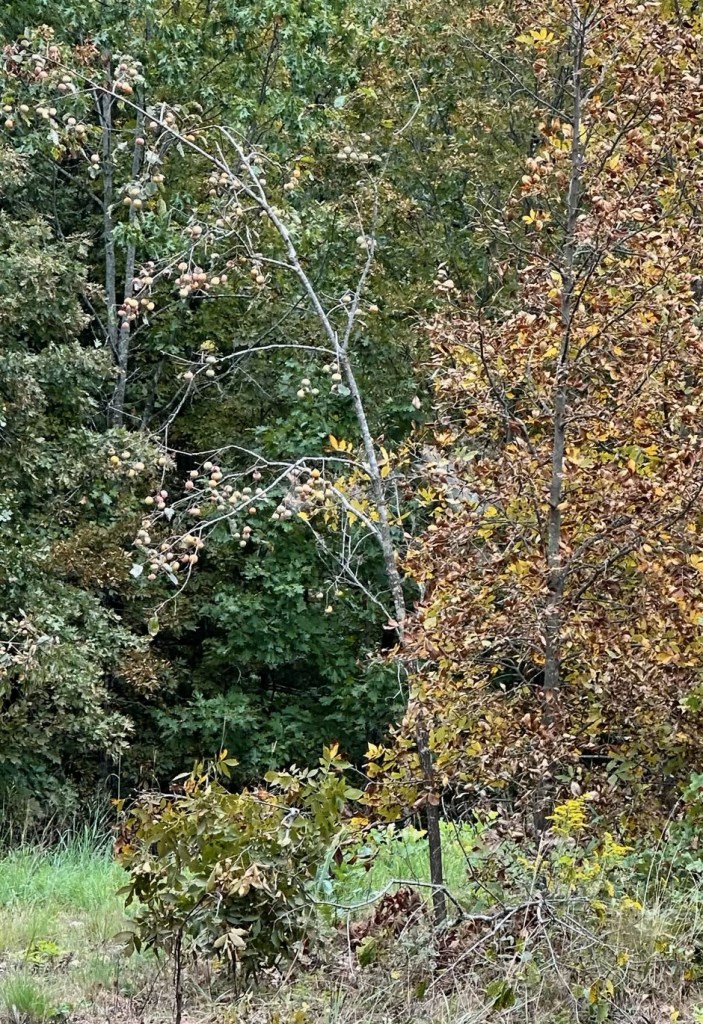
The other most popular, and equally unverifiable, winter weather predictor are the shapes inside persimmon pits. The folklore attributed to the Ozarks contends that the center of the seeds contain an image of a spoon, fork or knife. The spoon means to expect a lot of snow for shoveling, and the knife predicts cutting cold. The fork shape foretells a mild winter. (Do persimmon seeds in south Florida only have forks?)
As with the worms above there is no data to support the pseudo science, and I would expect it to be a safe bet that more people have injured themselves trying to open a slippery persimmon seed than ever successfully forecast any coming weather conditions.
One last natural phenomenon believed to have predictive power is the abundance of fruits and nuts produced by trees. The story says that if trees are set with scads of apples, acorns, and persimmons, the weather is bound to be bad. All that excess is provided to feed starving creatures through the cold and ensure that seeds will sprout to replace any trees that freeze to death.
While that seems mighty nice of Mother Nature to take care of her own, the abundant harvest is the result of weather activity in the past rather than a nod to the future. A late freeze in the spring didn’t nip the buds, pollinators found conditions favorable during flowering, and adequate rainfall kept the trees healthy through their growing summer season.
A climate concern that is irrefutably supported by science and data is the trending planetary temperature that may someday change how, where, when, and if we see woolly worms and persimmons in the future.
John Winkelman has been writing about outdoors news and issues in Jefferson County for more than 30 years and was the Associate Editor for Outdoor Guide Magazine.
 Don't Call Me Outdoor John